


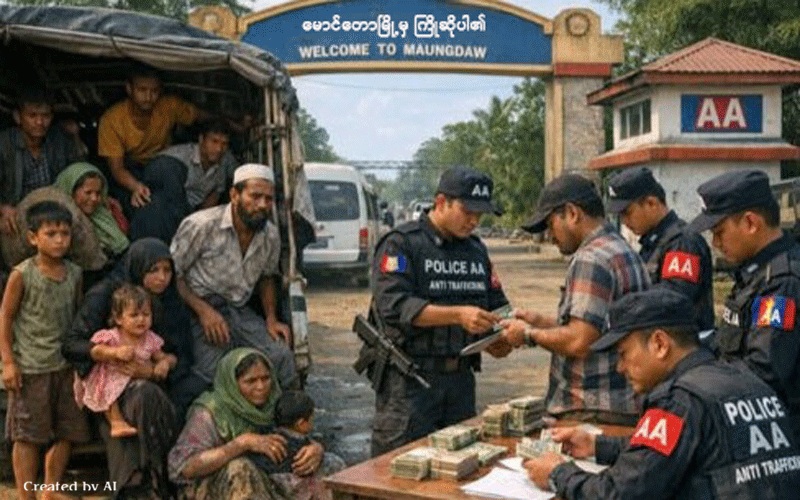
Rohingya civilians attempting to escape escalating repression in northern Rakhine State are reportedly being forced to pay large sums of money to pass through checkpoints while traffickers exploit their desperation to flee toward Bangladesh, according to testimonies gathered from community sources inside the region.
Residents from Buthidaung Township say a growing number of Rohingya families are attempting to leave their villages amid increasing restrictions, forced displacement, and economic pressure in areas controlled by the Arakan Army (AA).
Local sources claim that Rohingya attempting to travel from Buthidaung toward the border district of Maungdaw Township are required to pay significant “fees” at checkpoints before they are allowed to proceed.
A Price on Freedom
According to residents, Rohingya being transported by vehicle toward Maungdaw are now required to pay approximately 800,000 kyats per person at the township entrance gate.
Previously, payments were reportedly collected through immigration-related administrative offices in Buthidaung. However, witnesses say the collection point has now shifted to the entrance gate of Maungdaw town, where individuals attempting to move through the area are screened and charged.
Residents say those transported without paying the required fee risk arrest, detention, or imprisonment.
Community sources describe the fee structure as follows:
-
-
-
- 800,000 kyats for individuals aged 10 years and above
- 500,000 kyats for children under 10 years old
- Infants and nursing children are reportedly exempt
-
-
For many Rohingya families already struggling with extreme poverty, the cost represents months or even years of income, forcing some households to sell belongings or borrow money simply to escape.
Checkpoints Along the Route
In addition to the main entrance payment, Rohingya travelers reportedly face additional fees at multiple checkpoints between Buthidaung and Maungdaw.
Local residents identified at least three checkpoints where payments are allegedly demanded:
-
-
-
- Buthidaung strategic checkpoint
- Six-mile checkpoint
- Three-mile checkpoint
-
-
At each of these locations, travelers are reportedly required to pay 50,000 kyats per person.
Residents say that these fees are demanded even from civilians traveling for routine purposes, further tightening restrictions on Rohingya movement across northern Rakhine.
A System of Economic Control
Beyond checkpoint payments, residents report the introduction of new taxation policies targeting Rohingya communities.
According to village sources, since 19 July 2025, tax collectors affiliated with the administrative structures of the Arakan Army have been collecting monthly payments from Rohingya households.
Reported tax rates include:
-
-
-
- 3,000 kyats for small huts
- 5,000 kyats for modest houses
- 10,000 kyats for larger homes
-
-
Residents say these taxes must be paid every month, adding further pressure on communities already facing severe economic hardship.
A Rohingya village elder described the system as unprecedented.
“During previous governments we never had to pay taxes on our homes,” the elder said. “We paid land tax and sometimes shop tax, but now we are taxed from every direction—even on our houses.”
He added that some villagers increasingly fear that the new system resembles authoritarian taxation practices imposed on a marginalized minority.
Growing Desperation Among Rohingya Communities
The reports emerge amid a broader climate of insecurity affecting Rohingya communities across northern Rakhine.
Local residents say Rohingya villages in Buthidaung have experienced:
-
-
-
- Forced displacement from villages
- Arbitrary arrests and detention
- Strict restrictions on movement
- Allegations of forced recruitment into armed forces
-
-
Human-rights observers warn that such conditions create a coercive environment pushing civilians toward irregular migration routes.
In many cases, traffickers are reportedly taking advantage of this desperation, offering dangerous journeys toward Bangladesh in exchange for large sums of money.
Implications for Regional Security
Analysts warn that the situation in northern Rakhine State could have significant consequences for regional stability.
The Arakan Army, which has expanded its territorial influence during Myanmar’s ongoing civil conflict, has established parallel governance structures in areas under its control. While the group has sought international legitimacy as part of Myanmar’s broader resistance movement, critics say the treatment of Rohingya communities under its administration raises serious concerns.
Human-rights advocates argue that discriminatory restrictions on Rohingya movement and economic activity risk perpetuating long-standing patterns of exclusion and persecution against the Muslim minority.
Pressure on Bangladesh
Any renewed displacement of Rohingya civilians would likely place additional strain on humanitarian operations in Cox’s Bazar, home to the world’s largest refugee settlement.
More than 1.4 million Rohingya refugees already live in camps across southeastern Bangladesh after fleeing waves of violence in Myanmar, particularly during the military crackdown of 2017.
Humanitarian agencies warn that worsening conditions inside Rakhine State could trigger new refugee flows, complicating diplomatic efforts aimed at achieving a safe, voluntary, and dignified repatriation process.
Calls for International Attention
Human-rights advocates say the situation highlights the urgent need for greater international monitoring of conditions inside Rakhine State.
Analysts stress that without meaningful accountability and protection mechanisms, Rohingya communities may remain trapped between armed actors, economic exploitation, and systemic discrimination.
For many Rohingya families still living in Buthidaung villages, however, the crisis is deeply personal.
As one local source explained:
“People are not leaving their homes because they want to. They are leaving because they feel they have no choice.”


