


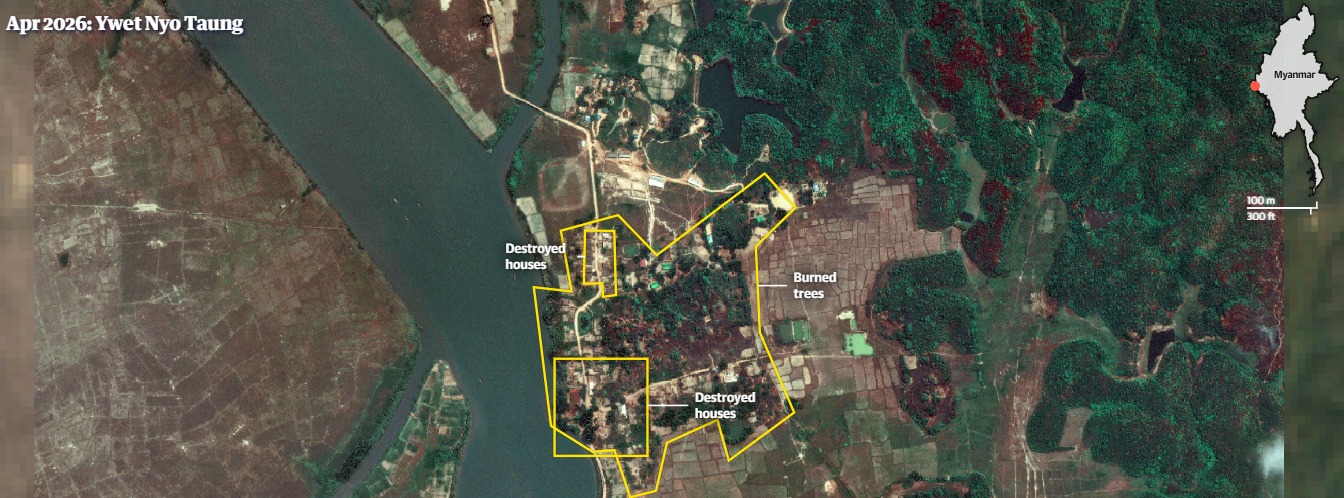
The Arakan Army (AA) has allegedly seized and repurposed Rohingya land across northern Rakhine State for detention camps, military facilities and new settlements since expanding its territorial control in 2024, according to an investigation by The Guardian based on satellite imagery, United Nations research and testimony from Rohingya survivors.
The investigation describes extensive changes to former Rohingya residential and agricultural areas in Buthidaung and elsewhere in northern Rakhine, where witnesses allege villages were destroyed, residents displaced and land subsequently used for AA-controlled facilities.
An internal UN report cited in the investigation documented at least 29 incidents involving alleged seizure of Rohingya land or displacement by the AA since 2024, affecting at least 800 hectares across 23 Rohingya villages.
The AA has denied accusations that it committed war crimes against Rohingya civilians, saying its operations targeted military personnel and members of Rohingya armed groups.
Satellite images show buildings on former Rohingya farmland
One location examined in the investigation was a rice-growing area in Hnget Thay in Buthidaung Township, where Rohingya farmers cultivated land until 2024.
Satellite imagery from 2026 reportedly shows about 120 grey buildings constructed on the site.
According to the investigation, the structures form part of an AA-run detention camp holding displaced Rohingya families from surrounding communities, whose movement in and out of the facility is restricted.
The report said the AA has established at least 10 such camps since taking control of most of northern Rakhine State.
The findings have intensified concerns among Rohingya communities that displacement caused by the latest conflict could become permanent if homes, villages and agricultural land are repurposed while their original residents remain unable to return.
Survivors describe villages being erased
Along the Mayu River in the Wet Nyo Taung area, about three miles from the reported Hnget Thay detention facility, Rohingya farmers and boatmen said they lost houses, farmland and fruit orchards after their communities were burned in April 2024.
“They cut down all the large trees and fruit orchards and cleared the entire land,” Muhammad Sadiq, 26, was quoted as saying.
“They completely erased the physical structure of the village. They built houses on our land.”
Survivors further alleged that Rohingya residents were forced to dismantle their own homes and use the materials to construct AA facilities, including military barracks in the Wet Nyo Taung area.
Sadiq alleged that Rohingya were also forced to clear roads, dig trenches and perform manual labour inside military camps.
Rohingya allege forced labour and recruitment
The investigation contains further testimony alleging forced labour, arbitrary detention and forced military recruitment.
Muhammad Ares, an 18-year-old Rohingya refugee now living in Bangladesh, said fighting intensified after the AA entered his area.
“Many civilians were killed during the fighting,” he said, alleging that the AA subsequently burned his village and forced displaced residents into camps.
Ares described the resulting system as a network of forced-labour camps and military bases.
Another man interviewed for the investigation said he was forcibly recruited and repeatedly beaten during approximately one month in detention.
A separate witness alleged that AA members took away his 22-year-old daughter, subjected her to physical and sexual abuse and forced her to undergo military training.
These are serious allegations based on survivor testimony and information cited in UN reporting. KPN has not independently verified the individual accounts.
UN research documents land seizures
An internal UN report cited by The Guardian said at least 800 hectares of land across 23 Rohingya villages had been seized since 2024 for camps, settlements for other communities or military infrastructure.
UN research reportedly documented at least 29 incidents involving alleged AA seizure of Rohingya land or displacement of Rohingya residents during the period.
The findings raise significant questions about whether Rohingya displaced by the conflict will be able to reclaim their houses and agricultural land if security conditions eventually allow them to return.
Nicholas Koumjian, head of the UN-backed Independent Investigative Mechanism for Myanmar, cautioned that the mechanism had not yet confirmed information establishing AA responsibility for the destruction of Rohingya land.
“It appears that all parties to the ongoing conflict are targeting the Rohingya who remain inside Myanmar,” Koumjian was quoted as saying.
More than 155,000 Rohingya flee since 2024
More than 155,000 Rohingya have reportedly fled to Bangladesh since the renewed conflict intensified in 2024.
The new arrivals have joined an already enormous refugee population created largely by previous waves of persecution and displacement, particularly the Myanmar military’s 2017 campaign in northern Rakhine.
Bangladesh is now hosting about 1.2 million Rohingya refugees, according to figures cited in the source material.
A UN expert on Myanmar, speaking anonymously to The Guardian, warned that the latest developments could have profound consequences for the continued Rohingya presence in northern Rakhine.
“There is no question that this is the end of the Rohingya presence in northern Rakhine,” the expert was quoted as saying, warning that Rohingya could remain confined in “prison-like camps” while being prevented from returning home.
Survivors of Hoi Yar Sari killings among camp detainees
According to the investigation, many Rohingya held at the Hnget Thay camp survived violence at Hoi Yar Sari on May 2, 2024.
Human Rights Watch has listed more than 170 villagers as killed or missing in connection with the incident, including about 90 children, according to the material reviewed.
The AA has rejected allegations of war crimes in connection with attacks on Rohingya, maintaining that it targeted military personnel and members of Rohingya armed groups.
Could displacement amount to a war crime?
Legal experts cited in the investigation said the alleged pattern could have implications under international humanitarian law if supported by sufficient evidence.
Tom Dannenbaum, a professor of international law at Stanford University, said coordinated coercive acts against Rohingya and their separation from their home areas could potentially constitute the war crime of unlawful population transfer.
Whether the legal threshold has been met would depend on the evidence and circumstances surrounding individual incidents.
The allegations are particularly significant because the Rohingya have already experienced successive waves of displacement, restrictions and destruction of their communities.
Fears of irreversible erasure
Aung Kyaw Moe, who until recently served as the only Rohingya member of Myanmar’s exiled National Unity Government, said the issue extends beyond whether individual Rohingya can physically survive inside Myanmar.
“The question is whether conditions are being created that will make their permanent displacement, and the erasure of their physical, political and historical presence, irreversible,” he said.
For Rohingya communities, the reported transformation of former villages and farmland therefore raises a fundamental question: whether people forced from their homes will ever be able to return to the places from which they were displaced.
The allegations emerge as international scrutiny of the Rohingya crisis continues, including proceedings before the International Court of Justice over allegations that Myanmar violated the Genocide Convention in its treatment of the Rohingya.
The Guardian investigation and cited UN material do not establish final judicial findings against the AA. However, survivor testimony, satellite evidence and documented land-use changes are increasing calls for independent investigation, protection of Rohingya land and property rights, and guarantees that displacement caused by the conflict does not become permanent.


