


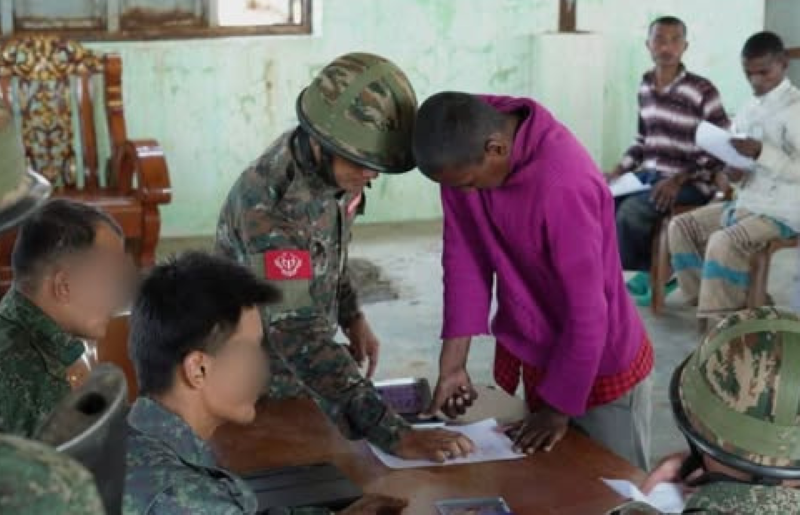
Residents in northern Maungdaw Township report that Rohingya administrators are being systematically excluded from land registration processes conducted under the authority of the Arakan Army/United League of Arakan (AA/ULA).
According to multiple local sources, officials from the Land Registration Department have been entering villages with minimal notice—sometimes as little as one day—to carry out documentation exercises.
On March 16, in Nga Khura village, land registration activities were reportedly conducted based solely on existing household registration lists, without consulting property owners or verifying family ownership claims.
Locals further allege that Rohingya administrators—despite being formally appointed—hold no effective authority within the process.
“They cannot sign documents. They have no decision-making power,” one resident said, noting that only a Rakhine administrator, identified as Maung Hla Win, is authorized to approve official records.
This has led to growing perceptions that Rohingya administrative roles are largely symbolic, lacking substantive governance participation.
While AA/ULA officials have publicly promoted principles of ethnic equality, local accounts suggest that decision-making authority remains concentrated within Rakhine leadership structures.
Analytical Context (Investigative Layer)
The reported marginalization of Rohingya administrators in land governance reflects a broader pattern of administrative exclusion in northern Rakhine.
Control over land registration is particularly significant, as documentation serves as a foundation for legal identity, property rights, and future citizenship claims.
Analysts warn that such practices could have long-term implications, including:
-
-
-
- Weakening Rohingya claims to ancestral land
- Restructuring demographic control through documentation systems
- Reinforcing asymmetrical power structures under AA/ULA governance
-
-
These developments are occurring alongside separate reports of forced recruitment, movement restrictions, and surveillance practices affecting Rohingya communities.
Taken together, they point to an emerging governance model where administrative control, documentation systems, and population management are deeply interconnected.


