


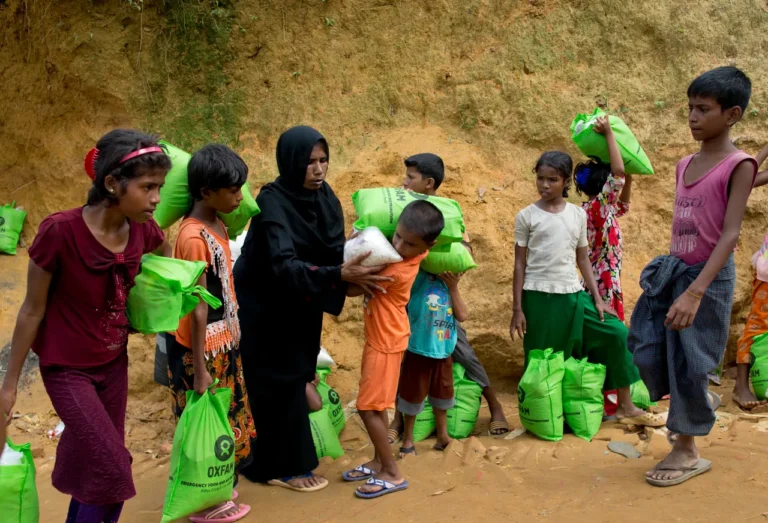
The looming reduction of food assistance for Rohingya refugees in Bangladesh represents not merely a funding shortfall, but a systemic failure of international responsibility-sharing under humanitarian and refugee law frameworks.
The World Food Programme (WFP) has confirmed that beginning April 1, monthly food aid for Rohingya refugees will be restructured under a tiered vulnerability system, effectively reducing assistance for a majority of the population. Currently set at $12 per person per month, food aid will be recalibrated to $12 for the “highly vulnerable,” $10 for the “moderately vulnerable,” and as low as $7 for those classified as “vulnerable.”
According to Bangladesh’s Refugee Relief and Repatriation Commissioner, approximately 67 percent of the 1.2 million Rohingya population will face reduced rations under this new framework.
A Crisis of Funding—and Political Will
Data from the United Nations Office for the Coordination of Humanitarian Affairs (OCHA) reveals a sharp and sustained decline in global funding commitments. The 2025 Joint Response Plan (JRP) for the Rohingya crisis required $934 million, yet only 53 percent of that target was met. This marks a downward trajectory from 64 percent in 2024 and over 70 percent in preceding years.
Humanitarian officials attribute this contraction not only to competing global crises but also to shifting geopolitical priorities, including reductions in U.S. foreign assistance during the administration of Donald Trump, which significantly disrupted humanitarian financing pipelines.
While a temporary injection of $73 million previously prevented drastic ration cuts, no comparable commitments have been secured for 2026, raising serious concerns over continuity of life-saving assistance.
Humanitarian Implications: Malnutrition, Instability, and Rights Violations
From an international law perspective, the reduction of food assistance raises critical concerns under the right to adequate food, enshrined in instruments such as the International Covenant on Economic, Social and Cultural Rights (ICESCR).
Although Rohingya refugees are not formally citizens of Bangladesh, the principle of non-refoulement and obligations under customary international humanitarian law impose a duty on both host states and the international community to ensure minimum standards of survival and dignity.
A reduction to $7 per month—widely regarded by humanitarian experts as below subsistence level—risks triggering:
-
-
-
-
- Acute and chronic malnutrition, particularly among children
- Increased vulnerability to exploitation, including trafficking and forced labor
- Social instability within already overcrowded camps in Cox’s Bazar
- Heightened security risks for both refugees and host communities
-
-
-
Protracted Displacement and the Collapse of Repatriation Narratives
Nearly a decade after the 2017 Rohingya crisis, conditions for safe, voluntary, and dignified repatriation remain absent.
Ongoing armed conflict between Myanmar’s military and the Arakan Army continues to destabilize Rakhine State, eliminating any realistic pathway for return. This directly contradicts earlier political assurances made in the presence of António Guterres, where commitments were made to pursue repatriation in coordination with the United Nations.
From a legal standpoint, premature or coerced repatriation under such conditions would violate international refugee protections and could amount to constructive refoulement.
Accountability Gap: Where Is the International System?
The Rohingya crisis has long been framed as a test case for the credibility of the international system. Yet the current funding collapse underscores a widening accountability gap.
Key issues include:
-
-
-
- Donor fatigue without burden-sharing mechanisms
- Lack of enforcement of provisional measures ordered by the International Court of Justice (ICJ) in the genocide case against Myanmar
- Insufficient progress toward accountability through international criminal mechanisms
-
-
Despite ongoing proceedings related to alleged genocide and crimes against humanity, material conditions for survivors continue to deteriorate—raising ethical and legal questions about the effectiveness of global governance institutions.
Policy Imperatives: Preventing a Humanitarian Breakdown
To avert a full-scale humanitarian deterioration, immediate policy interventions are required:
-
-
-
- Emergency donor conference to close the funding gap in the 2026 Joint Response Plan
- Expansion of multi-year, flexible funding mechanisms to stabilize humanitarian operations
- Integration of development-based approaches, including education and livelihood access for refugees
- Strengthened diplomatic pressure on Myanmar to comply with international legal obligations
- Enhanced monitoring of human rights conditions in camps to prevent secondary protection crises
-
-
Conclusion
The reduction in Rohingya food aid is not an isolated administrative adjustment—it is a warning signal of systemic neglect. Without urgent corrective action, the international community risks compounding one of the gravest humanitarian and human rights crises of the 21st century.