


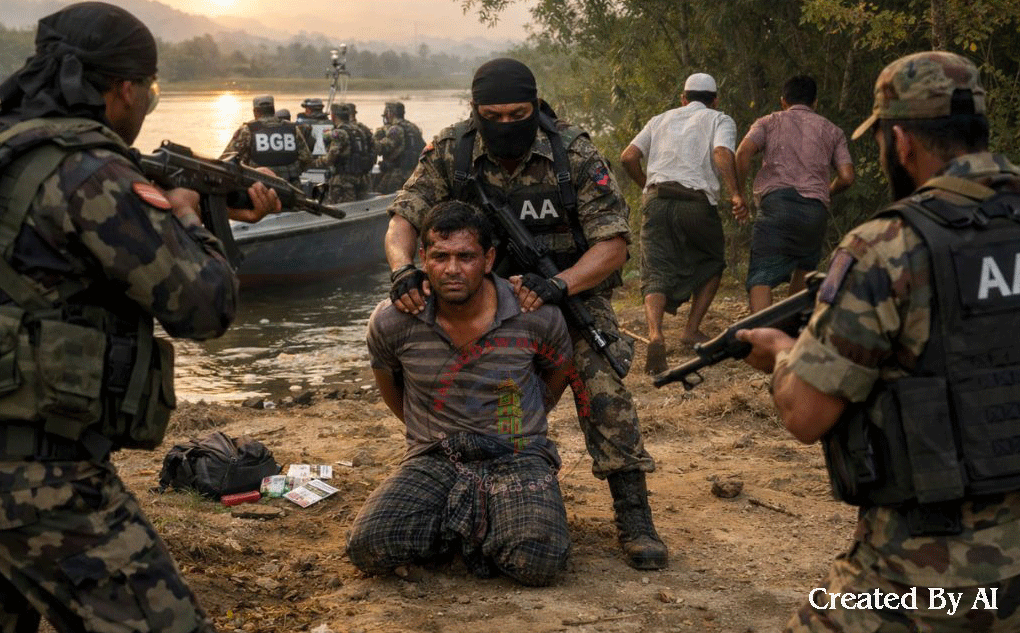
At least one Rohingya civilian has been arrested and two others remain missing following a shooting incident in Thayet Ok village, Maungdaw Township, according to local sources.
The three individuals were reportedly intercepted by Border Guard Bangladesh (BGB) while attempting to cross into Bangladesh via the Naf River for medical treatment, allegedly carrying documentation issued by the Arakan Army (AA). They were subsequently returned to Myanmar.
Local residents said that shortly after their return to Thayet Ok village, fighters from an AA base in Chaung Wa opened fire on the group for approximately ten minutes at around 5:12 p.m. on March 22.
One individual, identified as Halaya, 26, was detained during the incident, while the other two remain unaccounted for. Residents fear they may have been killed, although no bodies have been recovered.
The incident has intensified concerns over the safety of Rohingya civilians navigating restrictions on movement, access to healthcare, and the risks associated with armed group control in northern Rakhine State.
Investigative Analytical Context
This incident reflects a wider and increasingly documented pattern of coercive control and militarised governance in northern Rakhine, particularly affecting Rohingya communities.
Multiple field reports indicate that access to essential services—including healthcare—is often mediated through armed actors, with civilians required to obtain permissions or documentation that may later expose them to suspicion, punishment, or violence.
Analysts note that such dynamics are consistent with emerging patterns of forced or pressured recruitment, where:
-
-
-
- Movement restrictions limit civilian autonomy
- Administrative control by armed groups expands into daily life
- Individuals interacting with one authority risk retaliation from another
-
-
In several reported cases across Maungdaw and Buthidaung, Rohingya civilians have faced detention, disappearance, or violence after attempting cross-border movement, particularly when such movement intersects with competing claims of authority between state and non-state armed actors.
The use of medical travel as a controlled pathway further highlights how basic humanitarian needs are being securitised, increasing civilian exposure to risk.
Human rights observers warn that these patterns may contribute to systematic vulnerability, including forced recruitment, extortion, and population control mechanisms, raising urgent concerns under international humanitarian and human rights law.


