


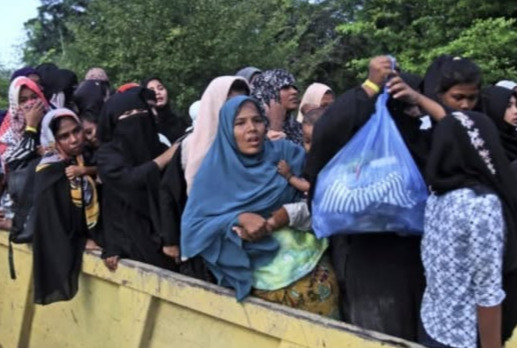
A group of 168 Rohingya civilians intercepted at the Bangladesh border has been returned to areas under the control of the Arakan Army (AA), where sources allege they are now facing significant financial penalties imposed by local authorities.
According to local residents and community sources, the group—comprising 19 families, including 76 men and 92 women—originated from Buthidaung Township and was transported to Maungdaw on April 18 by AA-affiliated personnel. Individuals above the age of 10 were reportedly required to pay a “head tax” of 100,000 kyats prior to the attempted crossing.
On April 19, members of Border Guard Bangladesh (BGB) detained the group near the frontier as they attempted to enter Bangladesh during nighttime hours. The group included infants, elderly individuals, and women.
Witness accounts indicate that after their detention, the group was returned to the Myanmar side of the border, specifically near the western shoreline of U Daung village in southern Maungdaw Township. Some sources allege that detainees were subjected to physical mistreatment during the process, although independent verification remains limited.
On the morning of April 20, AA personnel reportedly located the group and transferred them to local administrative authorities in Maungdaw Ward (2) later that night.
Subsequently, residents report that a local “jury” or administrative committee, in coordination with AA-linked authorities, has imposed additional financial demands—reportedly amounting to 500,000 kyats per individual—on those detained.
By April 21, the group had been moved to an intelligence facility, with preparations reportedly underway to transfer them to an undisclosed location by vehicle. Their current status and destination remain unclear.
Community members say the incident highlights the increasing risks faced by Rohingya attempting to flee northern Rakhine State, citing ongoing concerns over arbitrary detention, forced recruitment pressures, and discrimination. Those attempting to cross into Bangladesh are often caught between enforcement measures on both sides of the border, leaving them in a precarious and uncertain situation.


