


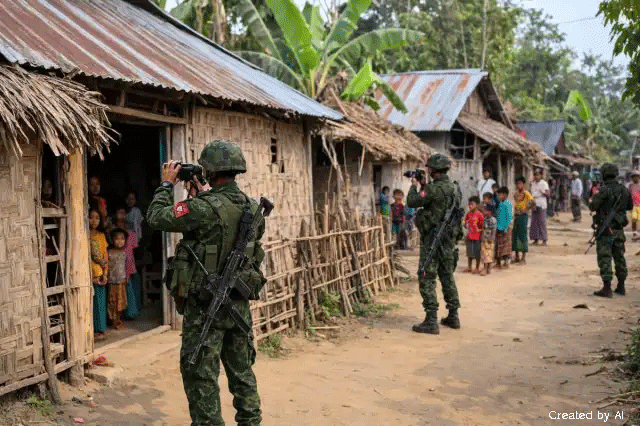
A recent operation by the Arakan Army involving systematic household inspections and data collection in Sai Daung village has raised significant concerns regarding civilian protection, surveillance practices, and the potential misuse of personal information targeting the Rohingya population.
According to multiple local accounts, armed members of the group conducted door-to-door checks, photographing homes, documenting family structures, and verifying the presence of individuals within each household. The operation, carried out over several hours, reflects a pattern of organized data-gathering in a highly vulnerable and conflict-affected area.
For Rohingya civilians—who have historically faced persecution, forced displacement, and systematic documentation-based targeting—such actions carry heightened risks. The absence of transparency regarding the purpose of these data collection efforts has intensified fears among residents.
Crucially, no official explanation has been issued by the Arakan Army, leaving open critical questions about whether the collected information could be used for population control, movement restrictions, or future security operations.
From an international humanitarian and human rights perspective, such practices may raise serious concerns under established norms relating to civilian protection, privacy rights, and non-discrimination, particularly in conflict zones where minority populations are already at elevated risk.
The Rohingya community, which remains largely stateless and lacks formal legal protections, is especially vulnerable to data-driven targeting. Past patterns in Rakhine State have demonstrated how population records and identity verification processes have been used to facilitate exclusion, surveillance, and, in extreme cases, mass displacement.
This latest development underscores the urgent need for:
-
-
-
- Increased international monitoring of conditions in Rakhine State
- Transparent communication from armed actors regarding civilian-related operations
- Stronger engagement by the United Nations and humanitarian agencies to ensure that data collection practices do not contribute to further rights violations
-
-
As conflict dynamics in Rakhine State continue to evolve, the situation highlights the growing risks facing Rohingya civilians caught between competing authorities, underscoring the need for sustained international attention and accountability mechanisms.