


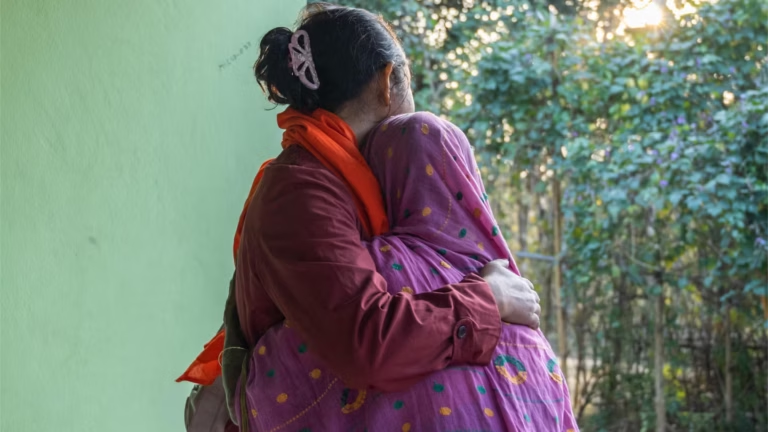
A new investigative report has revealed the widespread and deeply entrenched nature of gender-based violence (GBV) affecting Rohingya women and girls living in refugee camps in southern Bangladesh, raising urgent concerns about safety, justice, and long-term protection for one of the world’s most vulnerable displaced communities.
The report, titled “Trapped in Silence: Report on the GBV of Rohingya Women and Girls,” was jointly produced by the Asian Dignity Initiative and the Rohingya Human Rights Center following a year-long research project across Rohingya refugee settlements in Cox’s Bazar.
Based on 1,003 survey responses and 26 in-depth interviews with survivors conducted throughout 2025 across 33 refugee camps, the report provides one of the most comprehensive recent examinations of gender-based violence inside the camps.
Researchers say the findings expose a troubling pattern of abuse that remains largely hidden due to stigma, fear of retaliation, and limited access to justice.
A Displaced Community Facing Persistent Risks
The Rohingya Muslim minority has endured decades of discrimination and persecution in Myanmar, particularly in Rakhine State. After being stripped of citizenship under Myanmar’s 1982 Citizenship Law, the community faced systematic restrictions on movement, education, and livelihoods.
A massive military crackdown in 2016 and 2017 forced more than one million Rohingya to flee across the border into Bangladesh. Today, the refugee settlements around Cox’s Bazar form the largest refugee camp complex in the world.
While the camps have provided sanctuary from violence in Myanmar, the report concludes that displacement itself has created a new set of vulnerabilities—particularly for women and girls.
Hidden Epidemic of Gender-Based Violence
The investigation identifies several major forms of gender-based violence occurring within the camps, including:
-
-
- Early and forced marriage
- Intimate partner violence
- Sexual exploitation and abuse
- Harassment and coercion
- Economic and psychological abuse
-
Among these, intimate partner violence accounts for the majority of reported cases, often normalized within marital relationships due to entrenched patriarchal norms, economic hardship, and lack of accountability mechanisms.
Researchers found that child marriage remains widespread, with families frequently arranging marriages for girls at a young age.
Many parents say they believe early marriage provides protection from harassment or assault inside the camps, particularly in overcrowded environments where privacy and security are limited.
However, the report stresses that these practices often deepen girls’ vulnerability to domestic violence, reproductive health risks, and educational exclusion.
Structural Drivers: Poverty, Insecurity, and Camp Conditions
The report emphasizes that gender-based violence in the Rohingya camps is not simply a cultural issue but is rooted in broader structural conditions affecting refugee life.
Key drivers identified by researchers include:
-
-
- Severe overcrowding in camp shelters
- Restrictions on movement and employment
- Extreme poverty and aid dependency
- Gender inequality and harmful social norms
- Weak access to justice and legal protection
-
In addition, the presence of criminal gangs and armed networks operating within and around the camps has heightened insecurity for refugees.
Women and girls are particularly vulnerable when traveling to collect food rations, firewood, or water.
Poor infrastructure further compounds risks. Shared sanitation facilities—often lacking adequate lighting or security—are frequently cited by survivors as locations where harassment or assault occurs.
Survivors’ Voices: Trauma and Social Isolation
Interviews conducted for the report reveal the long-term physical and psychological consequences of gender-based violence.
Many survivors reported:
-
-
-
- chronic injuries
- untreated trauma
- depression and social isolation
- abandonment by spouses or family members
-
-
In several cases documented by researchers, women who attempted to report abuse faced social stigma or retaliation from their communities.
Some survivors were forced into unfair divorce arrangements or polygamous marriages, leaving them responsible for raising children alone with little or no financial support.
The report also highlights an often overlooked dimension of abuse: sexual violence against men and boys. While cases exist, survivors rarely report them due to intense stigma and lack of appropriate support services.
Barriers to Justice and Support Services
Although humanitarian organizations operate protection programs in the camps, researchers found that only a small proportion of survivors access medical, psychological, or legal assistance.
Several barriers prevent survivors from seeking help, including:
-
-
-
- fear of social stigma
- lack of confidential reporting systems
- language barriers between refugees and service providers
- corruption or informal dispute resolution systems
- limited availability of shelters and counseling services
-
-
Funding shortages have also restricted the expansion of safe spaces for women and girls, leaving many survivors without adequate protection.
Risk of Interlinked Exploitation and Trafficking
Human rights observers warn that gender-based violence in the camps can also intersect with broader forms of exploitation, including human trafficking.
Poverty, insecurity, and lack of livelihood opportunities have pushed some families to make desperate decisions—including marrying daughters at a young age or allowing them to travel with smugglers promising work abroad.
Recent regional monitoring has documented increased maritime departures of Rohingya refugees from the Teknaf–Bay of Bengal corridor, where trafficking networks operate routes toward Southeast Asia.
Women and girls are particularly vulnerable to sexual exploitation and forced marriage during trafficking journeys.
Calls for Urgent Action
The report calls for a comprehensive and survivor-centered response to address gender-based violence in the Rohingya camps.
Key recommendations include:
-
-
-
- increasing international funding for GBV prevention and survivor support programs
- expanding safe shelters, counseling services, and legal aid
- improving camp infrastructure, including lighting and security patrols
- strengthening community-based protection networks
- engaging religious and community leaders to challenge harmful social norms
-
-
Researchers also emphasize the importance of empowering Rohingya women and girls through education, vocational training, and participation in camp decision-making processes.
Beyond Humanitarian Aid
Ultimately, the report argues that addressing gender-based violence in the Rohingya camps requires more than short-term humanitarian assistance.
It demands justice, accountability, and long-term protection for a stateless population living in prolonged displacement.
Without stronger action from humanitarian agencies, policymakers, and the international community, the report warns that gender-based violence will continue to erode the safety, dignity, and resilience of Rohingya communities already struggling to survive in exile.