


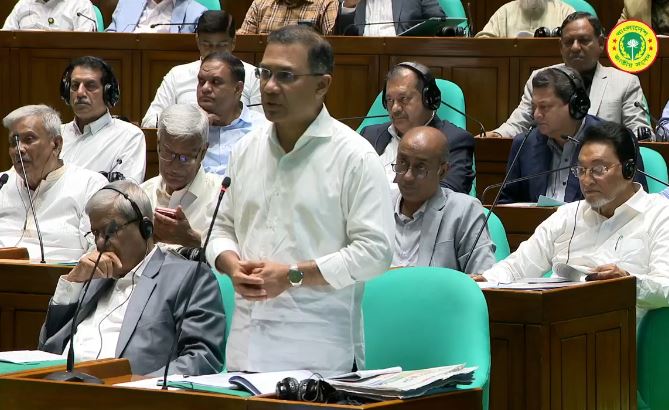
Bangladesh Prime Minister Tarique Rahman has reaffirmed his government’s commitment to achieving a peaceful, sustainable and swift resolution to the Rohingya crisis, saying Dhaka is pursuing intensified diplomatic engagement at bilateral, regional and multilateral levels to facilitate the safe, voluntary and dignified repatriation of forcibly displaced Rohingya refugees to Myanmar.
The Prime Minister made the remarks while responding to a starred question from Md. Selim Reza, Member of Parliament from Sirajganj-1, during the parliamentary question-and-answer session chaired by Speaker Hafiz Uddin Ahmad.
Diplomatic Efforts Guided by Past Experience
Prime Minister Tarique Rahman said Bangladesh’s current approach follows the diplomatic principles adopted during the governments of Shaheed President Ziaur Rahman in 1978 and Prime Minister Begum Khaleda Zia in 1992, when previous Rohingya refugee crises were resolved through diplomatic initiatives that enabled displaced Rohingyas to return to Myanmar.
“Today, we are pursuing a sustainable, peaceful and rapid solution guided by the same policy. The BNP government is conducting vigorous diplomatic efforts on bilateral, regional and multilateral fronts to achieve an early resolution of the Rohingya crisis,” the Prime Minister told Parliament.
Keeping the Rohingya Crisis on the Global Agenda
The Prime Minister said Bangladesh continues to work actively to ensure that the Rohingya crisis remains a priority on the international humanitarian agenda.
He noted that the government has maintained regular engagement with senior officials of the United Nations High Commissioner for Refugees (UNHCR), UN Women, and the World Food Programme (WFP).
Following the formation of the current government, high-level delegations from the three organizations visited the Rohingya camps in Cox’s Bazar to discuss expanding humanitarian assistance for refugees and host communities, he added.
International Support and Humanitarian Cooperation
Tarique Rahman also highlighted the recent official visit of Türkiye’s Foreign Minister to Bangladesh, including a tour of the Rohingya refugee camps in Cox’s Bazar.
“We hope this visit will lead to increased humanitarian assistance from Türkiye for the Rohingyas,” he said.
He further noted that a high-level conference at the United Nations last September focused on promoting the safe and timely repatriation of displaced Rohingya refugees.
According to the Prime Minister, Bangladesh will continue utilizing the UN and other international platforms to strengthen global support for resolving the crisis.
Justice, Accountability and Root Causes
The Prime Minister stressed that achieving justice and accountability remains central to Bangladesh’s strategy.
He reiterated Bangladesh’s continued moral support for The Gambia’s case against Myanmar before the International Court of Justice (ICJ), describing accountability as essential for addressing the root causes of the crisis.
“We believe that a sustainable and effective solution to the Rohingya crisis lies in Myanmar’s Rakhine State,” he said.
He added that Bangladesh has intensified diplomatic engagement with the international community to encourage greater pressure on Myanmar to create conditions necessary for the safe, voluntary and sustainable return of Rohingya refugees.
Dialogue with Myanmar and Regional Stakeholders
The Prime Minister said Bangladesh continues to maintain communication with Myanmar authorities while also engaging relevant regional and international stakeholders.
He noted that confidence-building measures are under consideration alongside traditional diplomatic initiatives.
Verification of Rohingya identities is progressing regularly as an important prerequisite for repatriation, while third-country resettlement efforts are continuing in parallel, he added.
Security Situation Remains Key Challenge
Describing the Rohingya crisis as one of the world’s most complex humanitarian challenges, Tarique Rahman said progress depends largely on the security situation in Myanmar’s Rakhine State, international diplomatic pressure and the willingness of Myanmar authorities.
He also emphasized the importance of dialogue between the Myanmar government and the Arakan Army, saying Bangladesh has strengthened discussions with relevant countries to encourage a stable environment that would support repatriation.
Strengthening Camp Security and Coordination
The Prime Minister said the government has adopted comprehensive measures to improve security and humanitarian management inside the Rohingya camps.
He highlighted the work of the National Committee on the Coordination, Management and Law and Order of Forcibly Displaced Myanmar Nationals, chaired by the Home Minister, which oversees law and order, coordination with host communities and implementation of government decisions.
He also noted that the National Taskforce, comprising the Ministries of Foreign Affairs and Home Affairs, the United Nations and other stakeholders, continues to coordinate humanitarian assistance, strengthen strategic planning and accelerate repatriation efforts.
Government Reaffirms Commitment to Durable Solution
Concluding his remarks, Prime Minister Tarique Rahman said the government remains committed to achieving a realistic, lasting and internationally supported solution to the Rohingya crisis.
He reiterated that Bangladesh’s ultimate objective is to enable forcibly displaced Rohingya refugees to return to their homeland voluntarily, safely and with dignity.


