


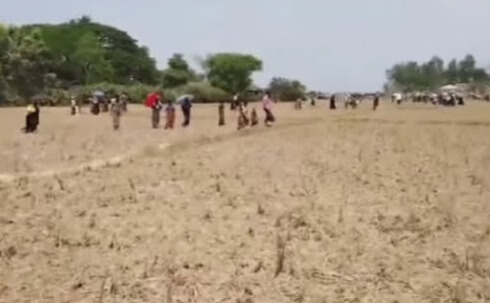
Serious allegations of collective punishment, forced displacement, and unlawful detention have emerged from Thu U Hla village (Khola Bhil) in northern Maungdaw Township, where the Arakan Army (AA) reportedly carried out a large-scale security operation targeting Rohingya civilians on the day of Eid.
Multiple local sources told media outlets that, beginning at approximately 10:00 a.m. on March 21, AA forces entered the village in significant numbers and forcibly ordered the entire population—including women, children, and infants—to leave their homes. The operation coincided with Eid observances, a timing that has intensified concerns among rights monitors regarding religious targeting and psychological intimidation.
Allegations of Fabricated Pretext and Mass Detention
Residents reported that the operation was triggered by what they described as a fabricated security narrative constructed by AA intelligence units. Under this pretext, villagers were reportedly detained en masse, subjected to interrogation, and prevented from returning to their homes for extended periods.
Eyewitness testimony indicates that:
-
-
-
- Civilians were held outdoors without access to adequate food, raising concerns of deliberate starvation or inhumane treatment
- Women, children, and elderly persons were reportedly confined in designated holding areas, including a local school facility
- Many Rohingya men fled to nearby villages amid fear of arrest or abuse
-
-
At the time of reporting, detainees had not been released, and the full scope of the operation remained unclear.
Destruction of Property and House-to-House Searches
Sources further allege that AA personnel conducted systematic house-to-house searches, forcibly entering locked homes and damaging civilian property. Reports describe:
-
-
-
- Breaking of doors and household structures
- Destruction of personal belongings
- Intrusions into private sanitation areas, including toilets and bathrooms
-
-
The village was reportedly sealed off, preventing movement in or out, effectively placing the population under de facto siege conditions.
Fear of Sexual Violence and Protection Risks
Community members expressed acute concern regarding the safety of Rohingya women and girls, with fears of potential sexual violence during detention. While no confirmed cases have been independently verified at the time of writing, such fears reflect a pattern of vulnerability documented in previous conflicts in Rakhine State.
Legal Analysis: Potential Violations of International Law
If substantiated, these actions may constitute serious violations under international humanitarian law (IHL) and international human rights law, including:
-
-
-
- Prohibition of collective punishment under customary IHL
- Unlawful confinement and arbitrary detention of civilians
- Forced displacement without imperative military necessity
- Destruction of civilian property not justified by military objectives
- Cruel, inhuman, or degrading treatment, including deprivation of food
- Heightened risk of conflict-related sexual violence, prohibited under international law
-
-
Given the Rohingya’s protected civilian status, such actions may also raise concerns under frameworks related to crimes against humanity, particularly if part of a broader pattern of persecution.
Geopolitical and Security Context
The incident occurs amid an increasingly complex conflict landscape in Rakhine State, where the Arakan Army has consolidated territorial control in several areas following intensified clashes with Myanmar’s military.
While the AA has sought to project itself as an alternative governing authority, incidents such as this risk undermining its claims to civilian protection and legitimacy, particularly in ethnically mixed or Rohingya-majority regions.
For the Rohingya population—already subjected to decades of systemic discrimination and statelessness—the reported operation reinforces fears of multi-actor persecution, where risks persist irrespective of which armed actor controls territory.
International Response and Accountability Imperatives
The reported events are likely to intensify calls for:
-
-
-
- Independent international investigations, including UN-mandated fact-finding mechanisms
- Enhanced monitoring by the Office of the United Nations High Commissioner for Human Rights (OHCHR)
- Documentation for ongoing accountability processes, including cases before international courts
-
-
Human rights advocates emphasize the urgent need for:
-
-
-
- Immediate release of arbitrarily detained civilians
- Unrestricted humanitarian access to affected populations
- Protection guarantees for women and children
- Transparent investigation into allegations of abuse
-
-
Conclusion
The Eid-day operation in Thu U Hla village, if verified, represents a deeply troubling escalation in the treatment of Rohingya civilians in Rakhine State. Beyond its immediate humanitarian implications, the incident underscores the urgent need for credible accountability mechanisms, sustained international scrutiny, and enforceable protections for vulnerable populations in Myanmar’s conflict zones.