


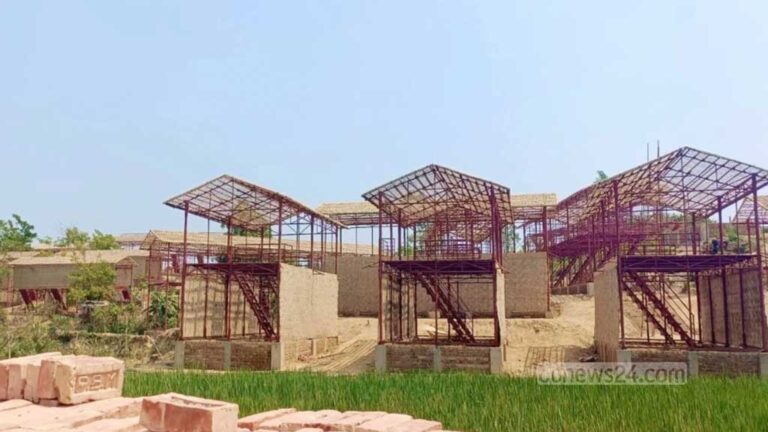
Bangladesh’s Forest Department has raised objections over the construction of nearly 900 two-storey housing units for Rohingya refugees in Cox’s Bazar’s Ukhiya upazila, alleging that hills and reserved forest land have been cut and levelled for the project.
The project, currently underway in the Extension ‘E’ block of Kutupalong Camp No. 4, involves the construction of approximately 888 iron-framed housing structures with concrete foundations, according to local officials and Forest Department sources.
The development has sparked debate among local residents and environmental officials over whether the new facilities contradict Bangladesh’s long-standing position that Rohingya refugees are staying in the country on a temporary basis.
Forest Department Protests Hill Cutting
Abdul Mannan, Range Officer of the Cox’s Bazar South Forest Division, said the department objected to the construction shortly after becoming aware of the project.
“This is reserved forest land under the Forest Division,” he said.
“Although camp authorities oversee activities inside the refugee camps, we strongly protested because extensive hill cutting and environmental destruction have taken place.”
According to the Forest Department, around 80 to 90 percent of the construction work has already been completed, with hundreds of labourers working simultaneously on the project.
Officials said roads have been cut through hilly areas to facilitate transportation and construction activities.
Environmental concerns include hill destruction, tree loss, soil erosion, and long-term ecological damage in an area already heavily affected by refugee settlements since 2017.
Authorities Say Structures Are Temporary
The Refugee Relief and Repatriation Commissioner (RRRC) and UNHCR maintain that the shelters are temporary and designed primarily to improve disaster resilience for refugees vulnerable to cyclones, landslides, and heavy monsoon rains.
Refugee Relief and Repatriation Commissioner Mohammed Mizanur Rahman said concerns surrounding the project were being “exaggerated.”
He explained that the housing design had previously been approved by an inter-ministerial committee during 2021–22.
While acknowledging that steel and limited concrete materials are being used, he argued that the structures should not be considered permanent settlements.
“It is not a fully concrete structure,” he said.
“A floor-type foundation is being provided so the shelters do not sit directly on the ground.”
The commissioner added that work involving hill cutting had been temporarily suspended following objections from the Forest Department.
UNHCR Defends Shelter Design
Mosharraf Hossain, spokesperson for UNHCR in Bangladesh, said the shelters are designed to improve safety and resilience in disaster-prone refugee camps.
According to UNHCR, the structures are built mainly with bamboo, plastic sheeting, and detachable steel pipe frames connected by nuts and bolts.
“These shelters are not permanent structures and do not indicate any change in the temporary status of Rohingya refugees in Bangladesh,” he said.
UNHCR also stated that the project design had received approval from relevant authorities.
Local Residents Voice Concerns
Local residents and community leaders say the scale and design of the project are creating fears that the Rohingya presence in Cox’s Bazar could become long-term or permanent.
M Gafuruddin Chowdhury described the construction as “concerning.”
“Strong infrastructure could encourage permanent settlement and weaken future repatriation efforts,” he said.
Many residents in host communities have also expressed concern over continued environmental degradation, pressure on local resources, and expanding infrastructure inside refugee camps.