


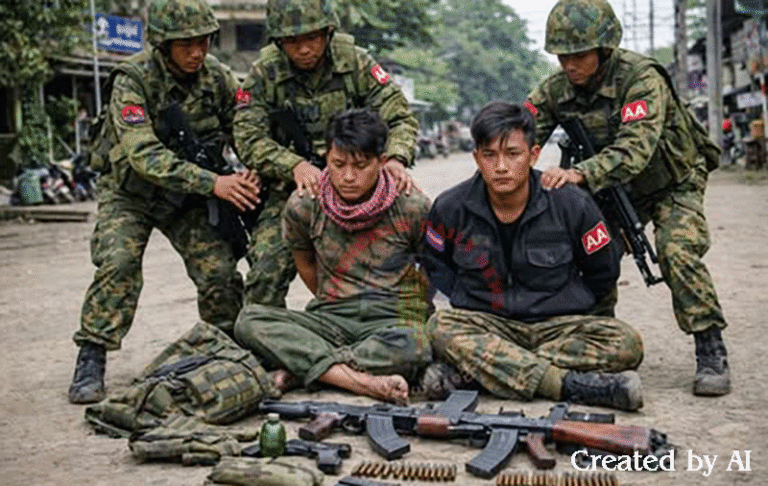
The arrest of two fighters from the Arakan Army (AA) in Maungdaw Township after fleeing with weapons from Buthidaung has brought renewed scrutiny to internal discipline mechanisms, emerging defection patterns, and the group’s increasingly complex recruitment strategies in northern Rakhine State.
Local sources report that at least 12 AA members deserted from a position in Buthidaung Township in recent days, taking arms and moving toward Maungdaw. Within hours of their disappearance, AA intelligence units launched a coordinated, low-profile search operation across the Buthidaung–Maungdaw corridor—an area that has become strategically sensitive amid shifting frontlines.
Two of the escapees have since been apprehended, while the remaining fighters are still being pursued.
Internal Discipline Under Pressure
The incident points to growing pressure within AA ranks as the group transitions from a guerrilla force into a quasi-governing authority across large parts of Rakhine State.
Armed organizations operating in contested territories often rely on strict internal discipline to maintain cohesion. However, recent field reports suggest that:
-
-
-
- Extended deployments and limited rotation cycles are contributing to fatigue among rank-and-file fighters
- Increased operational tempo amid ongoing conflict is straining command structures
- Intelligence-led internal surveillance has intensified to prevent desertion and unauthorized movement
-
-
The swift launch of a “secret search operation” indicates that the AA leadership treats defections—especially those involving weapons—as high-risk security breaches.
“Loss of armed personnel is not just a manpower issue; it is a potential intelligence leak,” noted a regional security analyst familiar with Rakhine dynamics.
Defection Patterns: Tactical Flight or Structural Signal?
While isolated defections are not uncommon in non-state armed groups, the reported escape of 12 fighters as a group suggests a more coordinated breakdown.
Analysts identify three possible drivers:
1. Operational Stress
Sustained combat conditions, particularly in volatile zones like Buthidaung, may push fighters to abandon positions.
2. Command Friction
Disagreements with local commanders or disciplinary actions can trigger collective desertion.
3. Fear of Redeployment
With frontlines shifting, fighters may resist redeployment into high-risk combat zones.
Notably, the escape route toward Maungdaw—an area with mixed ethnic composition and proximity to the Bangladesh border—raises questions about whether the group intended to cross borders, blend into civilian populations, or seek protection.
Rohingya Recruitment Dynamics: Between Inclusion and Control
One of the arrested individuals was identified as a Rohingya member of the AA—an increasingly significant detail in understanding the group’s evolving recruitment patterns.
Historically, the AA has been perceived as an ეთno-nationalist Rakhine force. However, in recent years, there has been growing evidence of Rohingya recruitment, particularly in northern Rakhine.
This development reflects both strategic adaptation and underlying tensions.
Why Recruit Rohingya?
-
-
-
- Local Knowledge: Rohingya recruits possess deep familiarity with terrain and communities
- Manpower Needs: Expansion of territorial control requires larger forces
- Operational Utility: Integration of local actors can facilitate intelligence gathering
-
-
Risks and Frictions
-
-
-
- Trust Deficit: Long-standing ethnic tensions complicate integration
- Dual Loyalty Concerns: Commanders may question allegiance in conflict scenarios
- Community Backlash: Recruitment can expose Rohingya civilians to reprisals
-
-
The arrest of a Rohingya fighter—reportedly linked to a local community figure—underscores the blurred line between armed structures and civilian networks.
Intelligence Operations and Social Penetration
The AA’s response—rapid arrests, localized intelligence gathering, and ongoing pursuit—demonstrates a high degree of territorial surveillance.
Residents describe:
-
-
-
- Night-time arrest operations based on informant networks
- Targeted searches in specific villages
- Immediate interrogation of detainees
-
-
Such methods indicate that the AA has developed a layered intelligence apparatus capable of monitoring both its fighters and surrounding communities.
However, this also raises concerns about civilian exposure to security operations, particularly in Rohingya-majority areas.
Strategic Implications: Control vs. Cohesion
The incident reveals a fundamental tension facing the AA:
How to maintain centralized control while expanding across ethnically diverse and conflict-affected territories.
As the group consolidates power, it must simultaneously:
-
-
-
- Enforce discipline within its ranks
- Manage multi-ethnic recruitment
- Prevent intelligence leaks
- Sustain local legitimacy
-
-
Failure in any of these areas risks weakening both operational effectiveness and political positioning.
Conclusion: A Microcosm of a Larger Transition
The arrest of two fleeing fighters is not an isolated event—it is a micro-level reflection of broader transformations within the Arakan Army.
As the group evolves from insurgency to governance, internal fractures, recruitment complexities, and discipline challenges are likely to intensify.
For observers of the Rakhine conflict, such incidents provide rare insight into the internal mechanics of one of Myanmar’s most influential armed actors—at a time when control on the ground is as contested internally as it is externally.