


A Historic First for a Stateless Generation
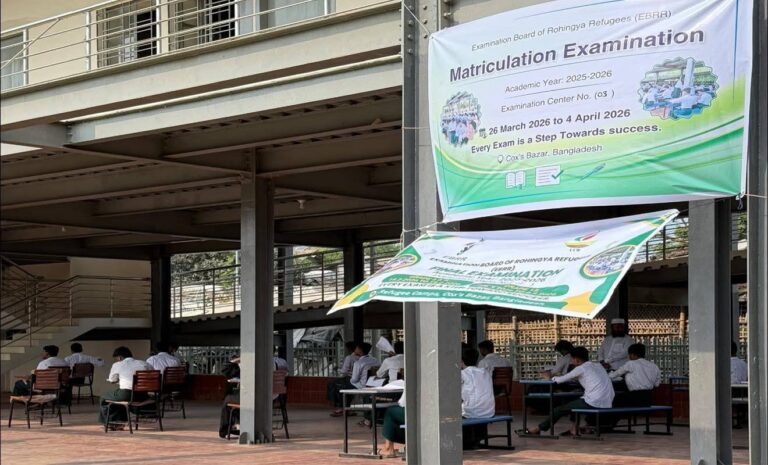
For the first time since their mass displacement, Rohingya students in Bangladesh’s refugee camps are sitting for structured matriculation examinations—an unprecedented step toward formalizing education for a community long denied academic continuity.
The exams, launched on March 26 by the Examination Board of Rohingya Refugees (EBRR), signal a shift from informal learning systems toward a more standardized academic framework inside the camps. For thousands of Rohingya youth, this marks their first opportunity to pursue recognized secondary-level education.
Yet, while the initiative is being hailed as a breakthrough, it also exposes a deeper structural dilemma: education without legal recognition.
Security, Structure, and System Design
The examination process has been conducted under strict logistical and security protocols. Question papers and answer scripts were distributed through coordinated channels involving camp authorities and Bangladesh’s Armed Police Battalion, ensuring controlled delivery across multiple camp-based examination centers.
The system itself mirrors Myanmar’s matriculation curriculum—a deliberate design choice.
Organizers argue that maintaining alignment with Myanmar’s academic framework allows Rohingya students to preserve educational continuity tied to their country of origin. In theory, this could support reintegration if repatriation becomes viable.
However, in practice, the absence of recognition from Myanmar’s authorities raises fundamental questions about the future validity of these credentials.
Education in Limbo: Recognition vs. Reality
At the core of the initiative lies a critical policy gap: certification legitimacy.
Rohingya students have historically been excluded from Myanmar’s formal education system due to citizenship restrictions and systemic discrimination. Now in Bangladesh, they face a different constraint—limited access to nationally accredited education pathways.
The EBRR exams operate in a parallel system: structured, organized, but not formally recognized by either state.
Education analysts warn this creates a “credential limbo,” where students may complete secondary education without gaining qualifications that are internationally or nationally accepted.
This raises urgent questions:
-
-
-
- Will these certificates be recognized in future repatriation scenarios?
- Can they be integrated into Bangladesh’s national education system?
- Will international agencies step in to validate or accredit such frameworks?
-
-
At present, none of these questions have clear answers.
A Policy Balancing Act for Bangladesh
Bangladesh hosts over one million Rohingya refugees, the majority concentrated in Cox’s Bazar. The government has maintained a cautious policy approach—allowing limited education access while avoiding long-term integration signals that could complicate repatriation diplomacy.
For years, formal secondary education for Rohingya refugees has remained restricted, with humanitarian actors largely confined to delivering informal learning programs.
The introduction of matriculation exams reflects a subtle policy evolution: expanding educational access without fully institutionalizing it.
This balancing act reflects broader geopolitical pressures—between humanitarian obligations, domestic constraints, and ongoing negotiations over repatriation to Myanmar.
The “Lost Generation” Risk
Humanitarian organizations have repeatedly warned of a “lost generation” risk among Rohingya youth—young people growing up without access to formal education, employment pathways, or legal identity.
Inside the camps, movement restrictions, limited job opportunities, and lack of higher education access have created a cycle of stagnation.
For many students, the matriculation exams represent more than an academic milestone—they are a psychological turning point.
Community members describe the initiative as a rare source of hope in an otherwise constrained environment.
Yet, without pathways beyond the exams—such as university access, vocational training, or recognized certification—the long-term impact may remain limited.
Repatriation, Reality, and the Education Question
The decision to adopt Myanmar’s curriculum underscores a persistent political assumption: eventual return.
But repatriation efforts have stalled for years, with no large-scale returns materializing since the 2017 exodus.
In this context, education planning becomes a paradox:
-
-
-
- Preparing students for a system they cannot currently access
- While limiting integration into the system where they currently live
-
-
This duality reflects the broader uncertainty surrounding the Rohingya crisis itself—caught between unresolved displacement and unfulfilled repatriation.
What Comes Next?
The matriculation exams may mark a turning point—but they are only a first step.
For the initiative to translate into meaningful long-term impact, several structural issues must be addressed:
-
-
-
- Accreditation: Establishing recognition mechanisms for exam results
- Continuity: Creating pathways to higher education or vocational training
- Policy clarity: Defining Bangladesh’s long-term education strategy for refugees
- International engagement: Expanding the role of global institutions in standardizing refugee education frameworks
-
-
Without these, the system risks becoming another temporary solution in a protracted crisis.
Conclusion
The launch of matriculation exams in Rohingya camps is both a milestone and a mirror—reflecting progress in access to education, while exposing the deeper legal and political constraints shaping refugee lives.
For Rohingya students, the exams represent possibility.
For policymakers, they represent a test: whether education in displacement can move beyond symbolism into a system that delivers real, recognized futures.