


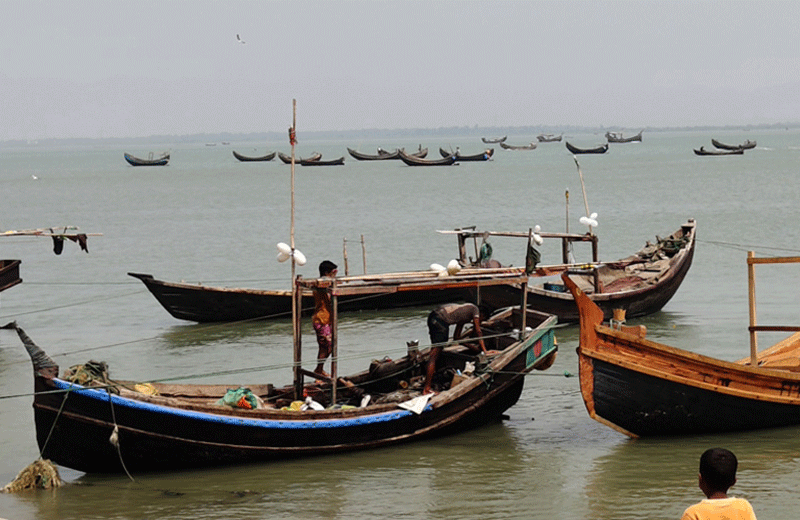
The abduction of 13 Bangladeshi fishermen and seizure of three trawlers near the Naf River this week marks the latest in a pattern of cross-border incidents involving the Arakan Army (AA), raising alarm over maritime security vulnerabilities and the growing spillover of Myanmar’s internal conflict into Bangladeshi territory.
Incident Overview
According to local authorities and community sources, the fishermen were intercepted on Saturday morning while returning from the Bay of Bengal near Shahporir Island, a sensitive coastal zone directly bordering Myanmar’s Rakhine State.
The victims, all residents of Sabrang Union under Teknaf Upazila, were taken along with three fishing vessels owned by local operators. Officials have confirmed that coordination efforts are underway with border security agencies, although no formal communication channel with the Arakan Army exists.
Cross-Border Security Analysis
Security analysts describe the Naf River corridor as an increasingly “unregulated grey zone,” where overlapping jurisdictions, porous maritime boundaries, and ongoing armed conflict in Myanmar create operational space for non-state actors.
The Arakan Army, engaged in a protracted conflict with Myanmar’s military, has expanded its effective control over large parts of northern Rakhine State. This territorial consolidation has enabled the group to project influence toward riverine and coastal zones adjacent to Bangladesh.
For Bangladesh, the implications are twofold:
-
-
-
- Territorial Sensitivity: While most abductions occur near disputed or loosely monitored waters, the psychological impact on Bangladeshi sovereignty is significant.
- Civilian Exposure: Fishing communities—economically dependent and minimally protected—remain the most vulnerable population.
-
-
The absence of clearly demarcated and jointly enforced maritime boundaries along sections of the Naf River further complicates enforcement and accountability.
Arakan Army Operational Patterns
Field reporting and local testimonies suggest that the Arakan Army’s abduction strategy is not random but follows identifiable patterns:
1. Target Selection
Fishermen operating in near-border waters are systematically targeted due to their mobility and lack of protection. Trawlers are often seized alongside crews, indicating both tactical and economic motivations.
2. Leverage and Negotiation
Abducted fishermen are typically held for periods ranging from days to months. Releases are often informal and may involve:
-
-
-
- local mediator networks
- financial payments or “fines”
- community-level negotiations
-
-
3. Resource Extraction
Fishing vessels and equipment may be repurposed or confiscated, suggesting logistical utility for riverine operations.
4. Psychological Control
Repeated abductions contribute to a climate of fear, effectively restricting civilian movement and consolidating de facto control over contested waterways.
Local data indicates that approximately 500 fishermen have been abducted over the past two years, with around 200 still unaccounted for—pointing to a sustained operational model rather than isolated incidents.
Bangladesh–Myanmar Maritime Tensions
Although Bangladesh and Myanmar are not in formal maritime conflict, the situation along the Naf River reflects latent tension shaped by asymmetry:
-
-
-
- Myanmar’s internal conflict has weakened centralized border control.
- Non-state actors like the Arakan Army operate with increasing autonomy.
- Bangladesh maintains a defensive posture, prioritizing containment over escalation.
-
-
Diplomatic engagement between the two states has largely focused on the Rohingya repatriation crisis, leaving maritime security coordination underdeveloped.
This strategic gap allows incidents such as abductions to persist without structured bilateral resolution mechanisms.
Human Security Impact
For communities in Teknaf and Shahporir Island, the consequences are immediate and severe:
-
-
-
- Loss of primary income sources
- Rising indebtedness among fishing families
- Increased reluctance to fish in traditional waters
- Long-term trauma and insecurity
-
-
Local residents report that entire family networks are affected, as fishermen are often sole earners.
UN and International Law Perspective
From an international legal standpoint, the abductions raise multiple concerns:
1. Violation of Civilian Protection Norms
Under international humanitarian law (IHL), non-state armed groups are prohibited from targeting civilians or engaging in hostage-taking.
2. Hostage-Taking Prohibition
The seizure of fishermen constitutes potential violations of:
-
-
-
- The International Convention Against the Taking of Hostages (1979)
- Customary international law applicable to non-international armed conflicts
-
-
3. Maritime Law Considerations
While the Naf River is not a high-seas zone governed strictly by the United Nations Convention on the Law of the Sea (UNCLOS), principles of safe navigation and civilian protection still apply in adjacent waters.
4. State Responsibility and Limitations
Myanmar, as the territorial state, holds primary responsibility for preventing non-state armed actions originating from its territory. However, the fragmented control in Rakhine State complicates enforcement.
Bangladesh, meanwhile, faces legal and operational limits in responding across the border, reinforcing a reliance on diplomacy and border security reinforcement.
Strategic Outlook
Without coordinated bilateral or multilateral mechanisms, analysts warn that such incidents may increase in frequency.
Key risk factors include:
-
-
-
- continued Arakan Army territorial expansion
- absence of joint maritime patrol frameworks
- economic vulnerability of coastal populations
- lack of formal переговоры channels with non-state actors
-
-
Conclusion
The latest abduction in Teknaf is not an isolated event but part of a broader pattern linking Myanmar’s domestic conflict to cross-border insecurity. As long as governance gaps persist along the Naf River, fishing communities will remain exposed to a cycle of abduction, release, and renewed fear.


