


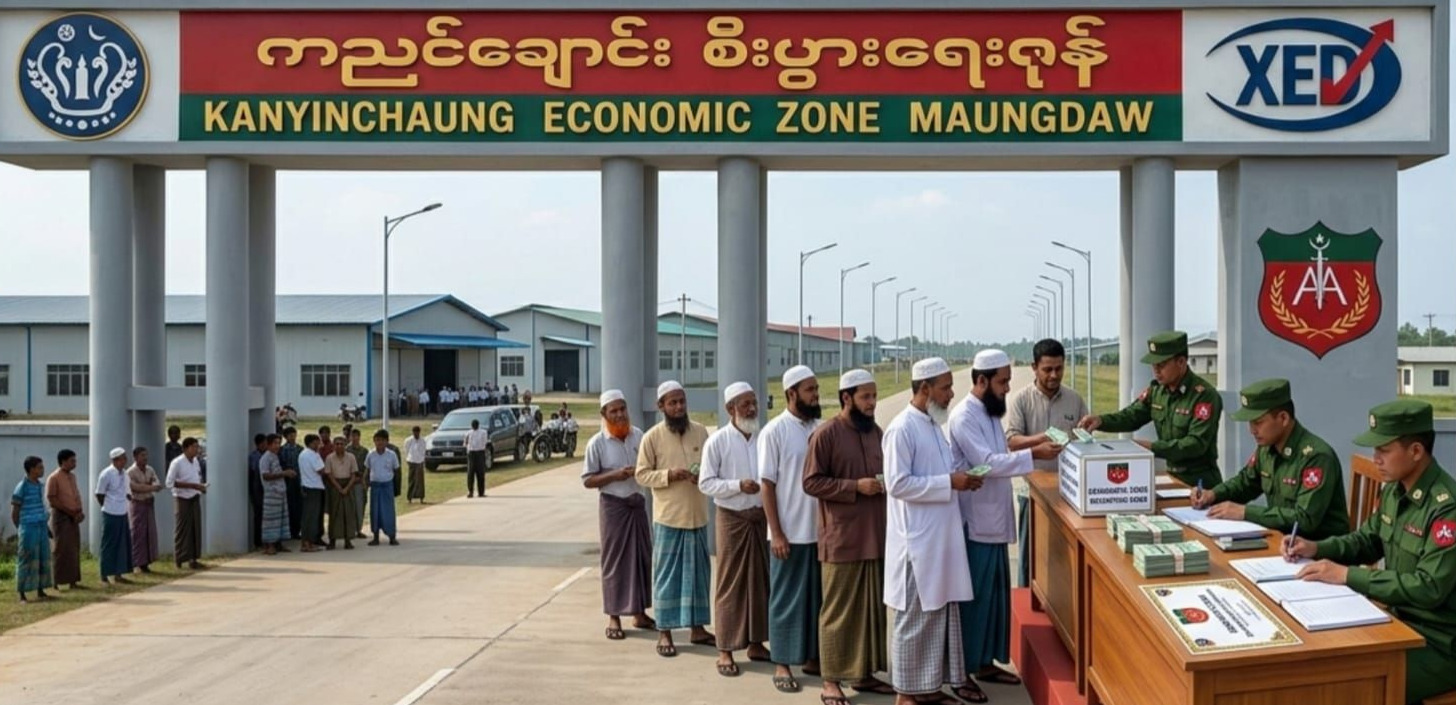
Reports from northern Rakhine State indicate that Rohingya businessmen are being compelled to finance infrastructure projects tied to emerging border trade corridors, raising serious concerns about coercion, informal taxation, and civilian protection under non-state armed governance.
On April 8, 2026, the Arakan Army (AA) reportedly summoned 15 Rohingya businessmen from villages in Area (6) of Maungdaw Township and demanded monetary contributions for the renovation of the Kanyinchaung Economic Zone, including road rehabilitation to support cross-border trade.
Local sources state that a combined total of approximately 1,000,000 kyats was collected, with individual payments ranging between 500,000 and 1,000,000 kyats. While framed as “emergency assistance,” testimonies suggest the payments were neither voluntary nor negotiable.
Extortion or Taxation? Legal Characterization Under International Frameworks
From a legal standpoint, the incident sits at the intersection of non-state taxation practices and prohibited coercive extraction under international humanitarian law (IHL).
While non-state armed groups exercising de facto territorial control may impose forms of taxation, such practices must meet minimum legal thresholds: transparency, proportionality, and absence of coercion. The reported use of threats and compelled participation raises red flags under Common Article 3 of the Geneva Conventions, which prohibits violence, intimidation, and degrading treatment against civilians.
Further, the extraction of funds under threat may constitute extortion, particularly where payments are not linked to lawful governance functions or where specific ethnic groups are disproportionately targeted. Legal experts note that such practices can also intersect with definitions of persecution if imposed discriminatorily on Rohingya civilians.
AA Governance Model: Revenue Generation in a Hybrid Authority Structure
The case illustrates the evolving governance architecture of the AA, which has expanded administrative control across parts of Rakhine State. Analysts describe this model as a hybrid system combining military authority with quasi-civil administration, including taxation, dispute resolution, and infrastructure management.
Revenue generation appears increasingly localized and project-based. Funding drives tied to economic infrastructure—such as the Kanyinchaung Economic Zone—suggest an attempt to operationalize territorial control through economic normalization.
However, the absence of formal accountability mechanisms raises concerns about arbitrariness and abuse. Rohingya communities, already marginalized, appear particularly vulnerable to such practices due to their limited legal protection and restricted mobility.
Border Trade Geopolitics: Maungdaw–Teknaf Corridor
The reported funding drive is closely linked to anticipated reopening of the Maungdaw–Teknaf trade route, a historically significant corridor connecting Myanmar’s Rakhine State with Bangladesh.
The Kanyinchaung Economic Zone is expected to function as a logistical hub, facilitating movement of goods toward Teknaf Port. For the AA, control over this corridor represents both strategic leverage and a potential revenue stream through customs-like practices.
For Bangladesh, particularly in the Cox’s Bazar–Teknaf region, renewed cross-border trade carries both economic opportunity and security risk. Informal trade flows have historically intersected with smuggling networks, including trafficking of people, narcotics, and goods.
In the absence of coordinated bilateral frameworks, the reopening of trade routes under non-state control may further complicate border governance and enforcement dynamics.
Escalating Coercion and Civilian Protection Risks
Separate reports from April 10 indicate that Rohingya village administrators in northern Maungdaw were summoned and allegedly threatened with destruction of homes if directives were not followed. Such incidents point to an escalation in coercive governance practices.
These developments heighten protection risks for Rohingya civilians, including:
-
-
-
- Forced financial extraction without legal recourse
- Collective punishment and threats to property
- Increased vulnerability to displacement
- Psychological trauma and community destabilization
-
-
Given the Rohingya’s stateless status and restricted access to justice mechanisms, avenues for redress remain virtually nonexistent.
A Pattern of Structural Vulnerability
The situation reflects broader structural dynamics affecting Rohingya populations in Rakhine State: exclusion from citizenship, limited freedom of movement, and exposure to multiple armed actors exercising overlapping authority.
In this context, economic initiatives—such as infrastructure development or trade corridor activation—risk reinforcing inequality if implemented without safeguards for civilian protection and equitable participation.
Conclusion: Governance Without Safeguards
The reported incidents in Maungdaw underscore the risks associated with emergent governance systems in conflict-affected regions. While infrastructure development and trade normalization may signal economic recovery, their implementation through coercive means undermines legitimacy and exacerbates civilian harm.
Without oversight, legal accountability, and inclusive policy frameworks, such practices risk entrenching a cycle of exploitation—particularly for vulnerable communities like the Rohingya.


