


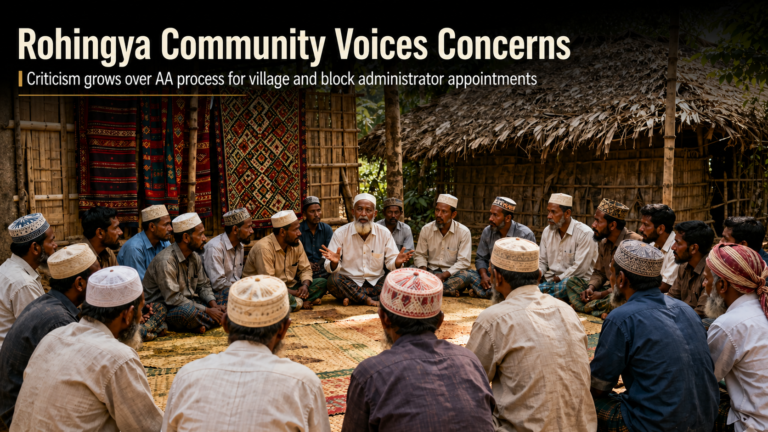
Residents in northern Rakhine State’s Maungdaw Township have raised growing concerns over the functioning of local governance under the Arakan Army (AA), citing alleged irregularities, bias, and lack of transparency in the appointment of new village administrators.
The criticisms come as the AA and its political wing, the United League of Arakan (ULA), expand administrative control across areas under their authority, establishing governance structures intended to replace previous state systems.
Concerns Over Appointment Process
Local residents report that, as part of the new administrative framework, each Rohingya village has been instructed to appoint a village administrator and an office clerk, with the additional requirement that the clerk position be held by a Rakhine individual.
However, community members allege that the selection process lacks community participation and is influenced by personal connections with AA/ULA officials.
In Shwe Zar village tract, residents say the current administrator was not chosen through local consensus but was instead appointed based on proximity to AA/ULA leadership.
“The village administrator was not selected by the people. He was appointed because he is close to AA/ULA officers,” said a Rohingya elder from the area. “The community does not accept him and is openly criticizing the decision.”
Allegations of Favoritism and Unequal Treatment
Residents also raised broader concerns about governance practices, alleging preferential treatment for individuals with ties to AA leadership.
A Maungdaw resident described what they see as a pattern of unequal treatment: “Those who are close to the officers receive better treatment, while ordinary people are treated differently. Even access to services can depend on connections.”
Others pointed to perceived economic favoritism, claiming that business opportunities are disproportionately accessible to individuals linked to local authorities.
Corruption and Accountability Challenges
Some residents further alleged the presence of bribery and exploitation at lower administrative levels, although they acknowledged that senior leadership may not be fully aware of these practices.
“There are many cases of exploitation at the grassroots level,” another resident said. “It may be difficult for higher authorities to monitor everything happening on the ground, but stronger oversight is needed in the administrative and judicial sectors.”
Observers note that as the AA/ULA transition from an armed movement to a governing authority, challenges related to accountability, institutional capacity, and rule of law are becoming increasingly visible.
Governance Transition Under Scrutiny
The AA’s expanding control in parts of Rakhine State has brought both expectations and scrutiny from local populations, particularly among Rohingya communities who remain vulnerable due to longstanding social and political marginalization.
Residents say that improving transparency, ensuring fair representation, and strengthening oversight mechanisms will be critical to building trust in the emerging governance system.