


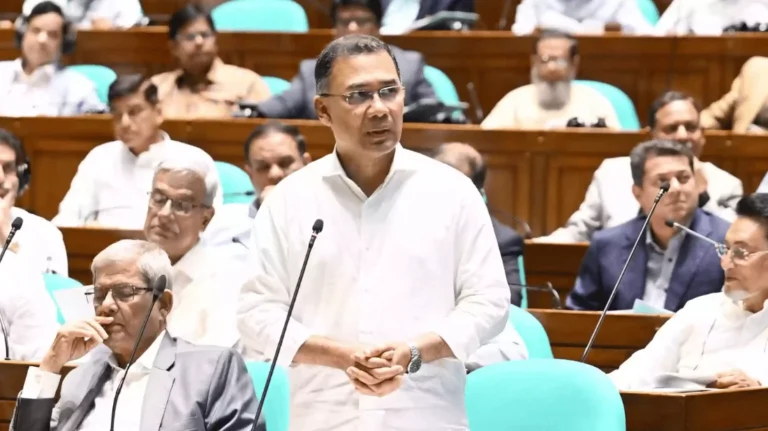
Bangladesh’s Prime Minister Tarique Rahman on Wednesday said his government is pursuing comprehensive diplomatic efforts at the bilateral, regional and multilateral levels to secure an early and peaceful resolution to the protracted Rohingya refugee crisis.
Speaking during the question-and-answer session in the Jatiya Sangsad, the prime minister reaffirmed that his government remains committed to ensuring the safe, voluntary and sustainable repatriation of forcibly displaced Rohingyas to Myanmar’s Rakhine State.
“The government is carrying out vigorous diplomatic efforts on all bilateral, regional and multilateral fronts to resolve the Rohingya crisis at the earliest,” Rahman said while responding to a starred question from Sirajganj-1 lawmaker Md. Salim Reza.
Government Reaffirms Repatriation Policy
The prime minister described repatriation as the only durable solution to the refugee crisis, stressing that Bangladesh continues to work with the international community to create conditions conducive to the safe return of Rohingya refugees.
He said previous BNP-led governments under former President Ziaur Rahman in 1978 and former Prime Minister Khaleda Zia in 1992 had successfully resolved earlier Rohingya refugee situations through diplomatic engagement.
“We are following the same policy to achieve a sustainable, peaceful and swift solution,” he said.
International Diplomatic Engagement
Rahman said the government is maintaining regular engagement with the United Nations, foreign governments and international development partners to keep the Rohingya crisis high on the global humanitarian agenda.
According to the prime minister, senior delegations from the UN Refugee Agency (UNHCR), UN Women and the World Food Programme (WFP) visited the Rohingya camps in Cox’s Bazar after the new government assumed office and discussed ways to strengthen humanitarian assistance.
He also referred to the recent visit of Türkiye’s foreign minister to Bangladesh, including a visit to the refugee camps, expressing hope that the visit would encourage additional humanitarian assistance from Ankara.
Bangladesh also supported last year’s high-level United Nations conference aimed at accelerating the voluntary repatriation process and will continue mobilising international support through similar global initiatives, he said.
Support for International Justice
The prime minister reiterated Bangladesh’s continued support for The Gambia’s case against Myanmar before the International Court of Justice (ICJ), saying justice and accountability remain essential to addressing the root causes of the Rohingya crisis.
He added that Dhaka has intensified diplomatic efforts to increase international pressure on Myanmar to establish conditions necessary for the refugees’ safe, voluntary and dignified return.
Dialogue with All Relevant Stakeholders
Rahman said Bangladesh is maintaining communication not only with Myanmar’s military authorities but also with all relevant stakeholders involved in efforts to facilitate future repatriation.
He noted that confidence-building measures, verification of Rohingya identities and third-country resettlement initiatives are continuing alongside diplomatic efforts.
The prime minister also highlighted the importance of creating a platform for dialogue between Myanmar’s authorities and the Arakan Army to help restore stability in Rakhine State.
Camp Security and Humanitarian Response
On the domestic front, Rahman said the government has adopted coordinated measures to strengthen security in the Rohingya camps, maintain harmony between refugees and host communities and improve humanitarian services.
A high-level national committee headed by the Home Minister is overseeing camp security and law enforcement, while a National Task Force comprising relevant government agencies, the United Nations and humanitarian partners is coordinating relief operations and supporting repatriation efforts.
Outlook
Describing the Rohingya crisis as a complex international challenge, the prime minister said its resolution depends largely on security conditions inside Myanmar’s Rakhine State, sustained international pressure and the willingness of Myanmar’s authorities to facilitate the refugees’ return.
He reaffirmed Bangladesh’s commitment to working with regional and international partners to achieve what he described as a realistic, peaceful and lasting solution that would allow Rohingya refugees to return home with safety and dignity.
Background information
More than one million Rohingya refugees remain in camps in Cox’s Bazar after fleeing violence in Myanmar in 2017, and no large-scale repatriation has yet taken place due to security and political conditions in Rakhine State.