


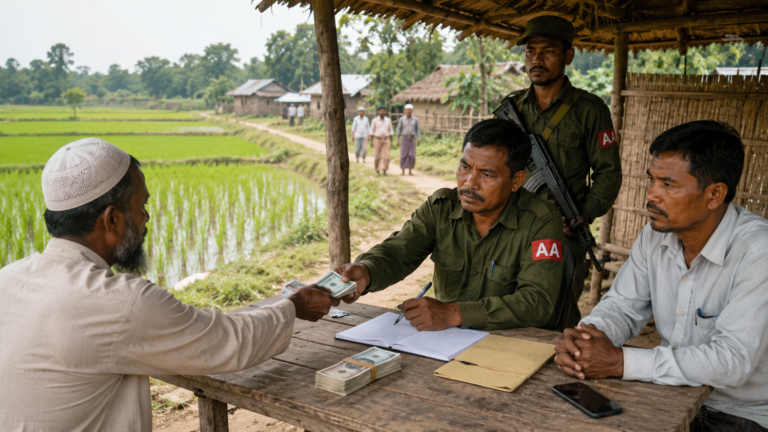
Rohingya residents of Oo Shin Kya village in northern Maungdaw Township have accused local administrators appointed under the Arakan Army (AA) and the United League of Arakan (ULA) of abusing their authority to extort money and threaten the confiscation of farmland belonging to Rohingya families.
According to multiple local residents, Oo Shin Kya village has recently been divided into nine administrative blocks. Abu, the son of Bawney Amin, and Mawti Raman have reportedly been appointed as interim village administrators.
Residents allege that Mawti Raman, together with Rofiq, the son of Inna Main, and a Rakhine resident identified as Zee Aung from Yemyat Taung village, have used their positions within the AA/ULA administration to demand payments from Rohingya landowners, including refugees currently living in Bangladesh.
According to local sources, the administrators are demanding 150,000 kyats per kani (approximately three acres) of farmland, warning that land belonging to those who refuse to pay could be confiscated.
Several residents also accused Abu, Mawti Raman, Rofiq, Bosir Ahmad, Shamsul Hakeem and Zafar of abusing their authority by intimidating villagers and exploiting their administrative positions.
Allegations of Planned Land Seizures
Residents further alleged that Mawti Raman and Abu are attempting to facilitate the seizure of farmland belonging to several Rohingya families.
According to local sources, the targeted properties include approximately 16 acres owned by Maulvi Sades, about 15 acres belonging to the family of Amir Hakim, and around two acres owned by Roji Ullah.
Residents claim the land could be taken through administrative measures, including the demolition of existing homes.
Concerns Over Administrative Appointments
Local Rohingya residents also questioned the process through which village administrators have been appointed under the AA/ULA administration.
Several residents alleged that many current administrators previously worked under Myanmar’s former military-backed administrations and had longstanding ties to previous authorities.
Others claimed that some individuals appointed to village-level positions have previously been associated with criminal activities, including illegal drug trafficking. These allegations could not be independently verified.
Residents said appointments were made without consultation with local communities and alleged that qualified Rohingya community members were excluded from administrative roles.
Calls for Investigation
Members of the local Rohingya community have appealed through the media for AA/ULA authorities to investigate allegations of corruption, abuse of authority and land-related extortion involving village administrators.
They have called for those found responsible for misconduct to face legal action in accordance with applicable laws.
The AA/ULA has not publicly responded to the allegations, and Kaladan Press Network was unable to independently verify the claims made by local residents.