


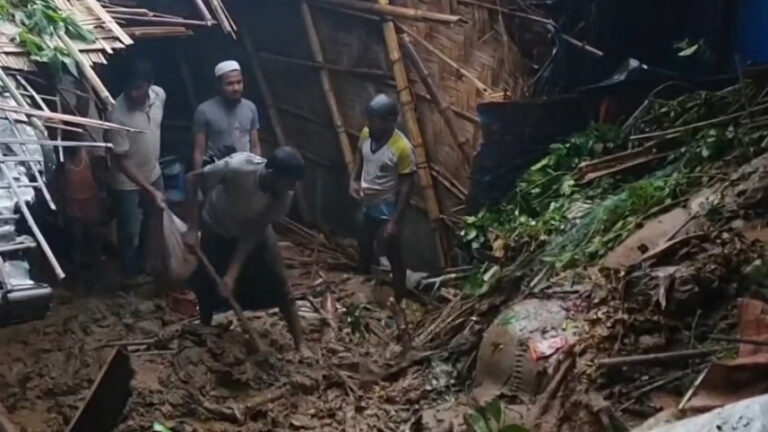
At least nine people, including eight Rohingya refugees and five children, were killed in a series of landslides triggered by torrential monsoon rain in southeastern Bangladesh early Wednesday, authorities said, as emergency officials warned that more landslides could occur with heavy rainfall expected to continue.
Eight of the fatalities occurred inside Rohingya refugee camps in Ukhiya Upazila, while another person died after a hillside collapsed in Cox’s Bazar municipality, according to local authorities.
Ukhiya Upazila Executive Officer Panna Akter said continuous rainfall and hill torrents caused multiple landslides across the refugee settlements during the early hours of the morning.
Four Killed in Camp 11
According to the Ukhiya Fire Service and Civil Defence, four Rohingya refugees died at around 3:00 a.m. after a hillside collapsed onto several shelters in Camp No. 11.
The victims were identified as Umme Habiba (27), Tanzina Akter (13), Mohammad Rihan (5), and Harunur Rashid (3). Another person sustained injuries in the incident.
Child Dies in Kutupalong Camp
Earlier, at approximately 1:45 a.m., seven-year-old Ekram was buried under mud carried by a hill torrent in Block D/7 of Kutupalong Camp No. 7 in Rajapalong Union.
Camp leader Enayet Ullah said Rohingya volunteers recovered the child’s body after residents alerted emergency responders.
Family of Three Killed in Jamtoli Camp
In another landslide around 1:10 a.m., a hillside collapsed onto the home of Rohingya refugee Mohammad Kamal Hossain in Block D/6 of Jamtoli Camp No. 15 in Palongkhali Union.
Rescue workers recovered the bodies of Kamal Hossain (44), his wife Humaira Begum (39), and their four-year-old son Mohammad Anas from beneath the debris.
Authorities Relocating Families from High-Risk Areas
Refugee Relief and Repatriation Commissioner Md Mizanur Rahman said persistent rainfall since Tuesday morning had saturated the hillsides, leading to multiple deadly landslides.
He said authorities were relocating refugees living in high-risk areas to safer locations in an effort to prevent further casualties.
One Killed in Cox’s Bazar Municipality
Outside the refugee camps, a separate landslide struck a home in the Sattar Ghona area of Ward No. 12 under Cox’s Bazar municipality at around 4:30 a.m.
The collapse critically injured Ali Akbar (50) and two members of his family. Ali Akbar later died after being taken to Cox’s Bazar District Sadar Hospital.
Officer-in-Charge Sheikh Mohammad Ali of Cox’s Bazar Sadar Model Police Station confirmed the incident, saying the remaining injured family members were receiving medical treatment.
Witness Mohammad Hashem said part of the hillside suddenly collapsed with a loud roar, burying the family inside their home before neighbours rushed to rescue them.
Heavy Rain Expected to Continue
Fire Service officials said rescue operations continued throughout the night as multiple landslides occurred within only a few hours.
The Ukhiya administration has been broadcasting emergency warnings through loudspeakers, urging residents in vulnerable areas to evacuate immediately.
According to the Cox’s Bazar Meteorological Office, more than 250 millimetres of rainfall was recorded during the 24 hours ending at 6:00 a.m. Wednesday.
Assistant Meteorologist Md Abdul Hannan said the heavy rainfall was being driven by a well-marked low-pressure system over the Bay of Bengal combined with an active southwest monsoon. Similar weather conditions are expected to continue for at least two more days.
Dozens of Landslide Casualties Recorded Since 2021
According to UNHCR Bangladesh Communications Officer Shari Nizman, landslides inside the Rohingya refugee camps killed 28 people and injured 80 others between 2021 and June 29, 2026.
UNHCR data show that:
2021: 8 killed, 23 injured
2022: 1 killed, 5 injured
2023: 3 killed, 10 injured
2024: 12 killed, 23 injured
2025: 2 killed, 9 injured
By June 29, 2026: 2 killed, 10 injured
Humanitarian agencies continue to warn that overcrowded camps built on unstable hillsides remain highly vulnerable during Bangladesh’s annual monsoon season, placing thousands of refugee families at ongoing risk.