


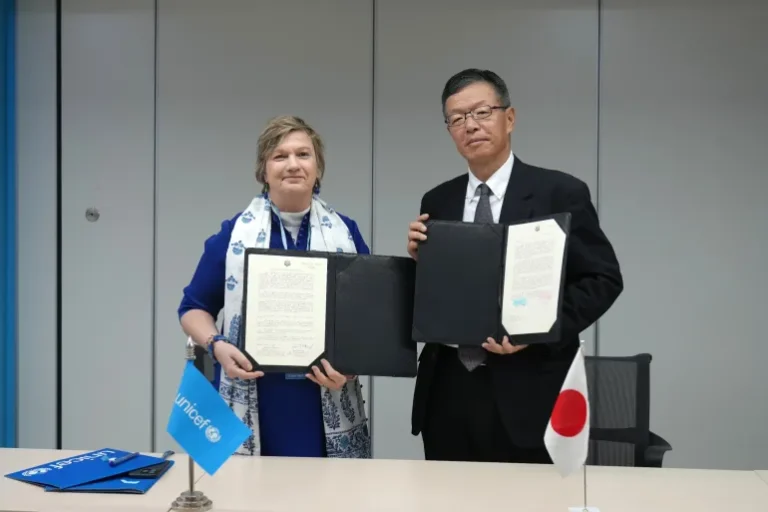
he Government of Japan and UNICEF have signed a new agreement aimed at providing life-saving humanitarian support to Rohingya refugee children and their families living in Cox’s Bazar and Bhasan Char.
Under the agreement, Japan will contribute US$1.4 million to support more than 56,500 Rohingya refugees, including over 36,000 children, through critical services in education, health, nutrition, and water, sanitation and hygiene (WASH).
The agreement was signed by Saida Shinichi, Ambassador of Japan to Bangladesh, and Rana Flowers.
Support for Children Amid Protracted Crisis
Now entering its ninth year, the Rohingya refugee crisis remains one of the world’s largest and longest-running humanitarian emergencies.
Children in the camps continue to face overcrowding, disease outbreaks, malnutrition, and limited access to safe learning environments.
According to UNICEF, the new funding will help sustain healthcare, nutrition services, clean water access, and education opportunities for Rohingya children while supporting the preservation of Rohingya culture and identity.
Ambassador Saida Shinichi said the initiative reflects Japan’s commitment to human security and humanitarian support despite declining global aid resources.
“I am pleased to announce Japan’s new agreement with UNICEF, especially amid declining global funding,” the ambassador said.
“This investment will help improve resilience and dignity for both Rohingya refugees and host communities, and Japan remains committed to supporting this humanitarian response,” he added.
Education and Skills Development
As part of the programme, UNICEF will expand access to the Myanmar curriculum on Bhasan Char and continue supporting formal education and skills training for Rohingya adolescents in Cox’s Bazar.
UNICEF Representative Rana Flowers warned that Rohingya children continue to face serious risks every day inside the camps.
“For Rohingya children, every day in the camps brings risks ranging from disease and malnutrition to interrupted education and lost childhood opportunities,” she said.
“At a time of shrinking humanitarian resources, this partnership is a critical investment in children’s survival, dignity, and future.”
Water, Sanitation and Health Services
The partnership will also strengthen water supply systems and sanitation facilities to help reduce outbreaks of cholera, dengue, and other infectious diseases in the camps.
Refugee households will receive hygiene supplies, including soap and menstrual hygiene materials.
UNICEF said the project will also scale up services aimed at preventing child malnutrition and improving maternal and newborn healthcare, including support for the Newborn Stabilization Unit on Bhasan Char and primary healthcare centres in Cox’s Bazar.
Japan’s Continued Support
Japan has been one of UNICEF’s longstanding development partners in Bangladesh for decades.
Since the beginning of the Rohingya refugee crisis in August 2017, Japan has contributed more than US$250 million to UN agencies and NGOs supporting Rohingya refugees in Bangladesh, including approximately US$47 million through UNICEF programmes for Rohingya children and families.