


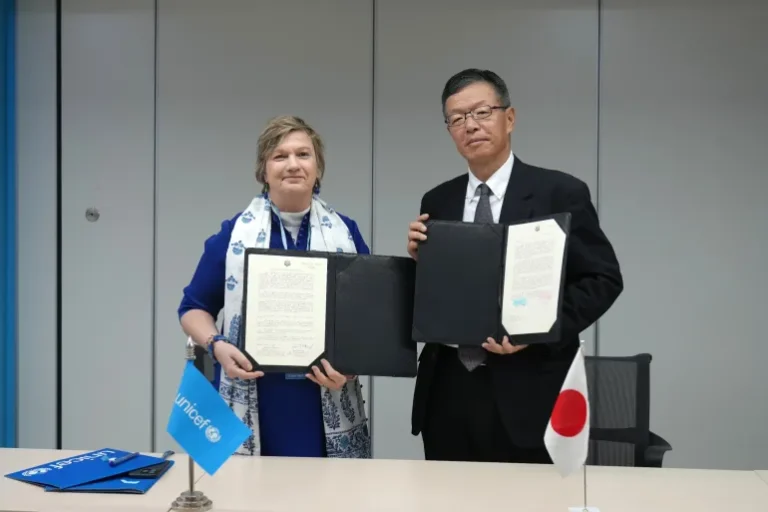
As global humanitarian funding for the Rohingya refugee response continues to decline, the Government of Japan and UNICEF have announced a new US$1.4 million assistance package aimed at protecting Rohingya children facing worsening health, education, and protection risks inside refugee camps in Bangladesh.
The agreement comes at a critical moment for the Rohingya humanitarian response, with aid agencies warning of increasing pressure on healthcare systems, food assistance, water services, and education programmes due to funding shortages and prolonged displacement.
A Crisis Entering Its Ninth Year
Nearly one million Rohingya refugees remain in camps across Cox’s Bazar and Bhasan Char after fleeing violence and persecution in Myanmar beginning in 2017.
What was initially treated as an emergency response has gradually evolved into one of the world’s most protracted refugee crises.
Aid workers say conditions inside the camps remain fragile, with overcrowding, poor sanitation, malnutrition, and limited educational opportunities continuing to place children at severe risk.
Humanitarian organizations have also warned of rising disease outbreaks, including cholera, dengue fever, respiratory infections, and waterborne illnesses, particularly during monsoon seasons.
International Funding Under Pressure
The Japan–UNICEF agreement arrives amid growing concerns over shrinking international donor support for the Rohingya response.
Several humanitarian agencies operating in Cox’s Bazar have already reduced services or scaled back staffing due to declining global aid contributions and competing international crises.
Humanitarian analysts say children and adolescents are among the most vulnerable groups affected by funding cuts.
“Education, nutrition, and child protection programmes are often the first to face reductions when humanitarian budgets tighten,” one aid official familiar with camp operations told KPN.
Education Seen as Protection
A major component of the new partnership focuses on expanding access to the Myanmar curriculum and skills training for Rohingya youth.
Education experts say maintaining educational continuity is essential not only for learning but also for protecting children from trafficking, child labour, forced migration, and recruitment into criminal networks.
UNICEF Representative Rana Flowers said the partnership would help children remain healthy and connected to learning opportunities despite worsening humanitarian pressures.
Aid agencies have increasingly described education as one of the few stabilizing factors for Rohingya youth growing up inside camps with little certainty about the future.
Bhasan Char Remains Controversial
Part of the funding will support services on Bhasan Char, where thousands of Rohingya refugees have been relocated by Bangladesh authorities.
While the government describes Bhasan Char as a safer and less overcrowded alternative to Cox’s Bazar camps, human rights organizations and some international observers have raised concerns regarding movement restrictions, long-term sustainability, and access to services on the remote island settlement.
Bangladesh authorities, however, maintain that the relocation programme has helped reduce pressure on overcrowded camps in Cox’s Bazar.
Humanitarian Aid and Political Realities
The new Japanese support also reflects growing international concern that the Rohingya crisis is becoming increasingly normalized despite the absence of a durable political solution in Myanmar.
Although humanitarian agencies continue expanding healthcare, nutrition, and WASH programmes, long-term repatriation prospects remain uncertain due to ongoing armed conflict and instability in Myanmar’s Rakhine State.
Analysts say donor countries such as Japan are attempting to balance humanitarian assistance with broader regional stability concerns.
Japan has remained one of the largest contributors to Rohingya humanitarian operations in Bangladesh, providing more than US$250 million to UN agencies and NGOs since 2017.
A Generation at Risk
More than half of the Rohingya refugee population in Bangladesh are children.
Aid workers warn that without sustained international support, an entire generation risks growing up without stable education, healthcare, or long-term opportunities.
For many Rohingya families, humanitarian assistance remains the only barrier between survival and deeper crisis.
As global attention shifts elsewhere, humanitarian agencies say continued international engagement will determine whether Rohingya children are protected — or forgotten.