


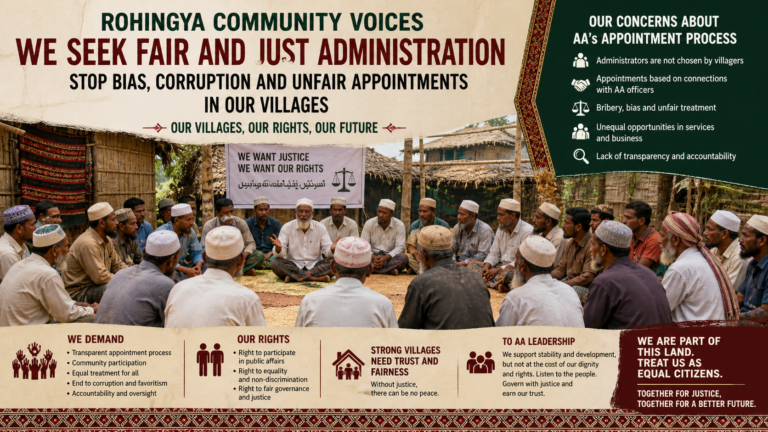
As the Arakan Army (AA) and its political wing, the United League of Arakan (ULA), consolidate control across northern Rakhine State, mounting criticism from residents in Maungdaw Township is raising fundamental questions about governance legitimacy, minority inclusion, and accountability under the emerging administration.
Interviews with local residents suggest that while the AA/ULA has moved rapidly to establish parallel administrative structures—replacing the institutions of the Myanmar state—the transition is marked by allegations of bias, opaque decision-making, and systemic inequality affecting Rohingya communities.
From Armed Movement to Parallel Administration
The AA’s governance model reflects a broader trend among non-state armed groups transitioning into de facto authorities. In Maungdaw, this has included the formation of village-level administrative bodies, judicial mechanisms, and public service systems operating independently of Naypyitaw.
However, the legitimacy of such structures depends not only on territorial control but also on procedural fairness, representation, and public trust—criteria that residents say are not being consistently met.
Local directives reportedly require each Rohingya village to appoint a village administrator and an office clerk, with the stipulation that clerical roles be held by ethnic Rakhine individuals. Critics argue that such requirements institutionalize ethnic hierarchy within governance structures.
Appointment Practices and Legitimacy Deficit
At the center of current grievances are allegations that local administrators are not selected through community-based processes but are instead appointed based on personal connections to AA/ULA officials.
In Shwe Zar village tract, residents say the current administrator was imposed without consultation, triggering widespread dissatisfaction.
“The administrator was not chosen by the villagers but by those close to the authorities,” a local elder said. “This undermines trust from the outset.”
From a governance perspective, such practices weaken input legitimacy—the principle that authority derives from the consent and participation of the governed—while also raising concerns about elite capture of local institutions.
Minority Rights and Discrimination Concerns
The reported administrative arrangements raise serious questions under international human rights norms, particularly regarding non-discrimination and minority protection.
While Myanmar is not fully aligned with all international treaties, principles embedded in frameworks such as the International Covenant on Civil and Political Rights (ICCPR) and customary international law emphasize equal participation in public affairs and protection from ethnic discrimination.
The requirement that Rohingya villages include non-Rohingya clerical oversight—combined with allegations of unequal treatment—suggests a system where ethnic identity influences access to authority and services.
Given the Rohingya’s long-standing exclusion from citizenship and governance, these developments risk reinforcing structural marginalization rather than addressing it.
Mapping Institutional Corruption and Patronage Networks
Residents’ testimonies point to patterns consistent with patronage-based governance, where access to services, economic opportunities, and administrative positions is mediated by proximity to power.
Key allegations include:
-
-
-
- Preferential treatment for individuals with ties to AA/ULA officials
- Informal payments or bribes influencing administrative outcomes
- Unequal access to business opportunities and local markets
- Discretionary enforcement of rules based on social or political connections
-
-
Such dynamics reflect what governance analysts describe as informal institutional capture, where official structures exist but are overridden by personal networks and loyalty systems.
Notably, some residents caution that senior leadership may lack full visibility over these practices, pointing to a gap between central authority and local implementation.
Continuity or Change? Comparison with Previous State Systems
A striking element of local criticism is the perceived continuity between current practices and those associated with previous Myanmar government administrations.
“For ordinary people, the methods feel familiar,” one resident said, referencing patterns of bribery, favoritism, and administrative arbitrariness historically reported under state structures.
This comparison highlights a critical challenge for the AA/ULA: distinguishing its governance model from past systems widely criticized for corruption and discrimination.
While the AA has positioned itself as an alternative authority promising reform and local empowerment, failure to address these issues risks replicating the very governance deficits it seeks to replace.
Protection Risks and Social Stability
The implications extend beyond governance theory into tangible risks for civilians. For Rohingya communities, perceived exclusion and unfair treatment can lead to:
-
-
-
- Reduced access to basic services
- Heightened economic vulnerability
- Increased social tensions between communities
- Erosion of trust in local institutions
- Greater exposure to coercion and exploitation
-
-
In fragile post-conflict environments, such dynamics can undermine stability and complicate efforts at reconciliation and inclusive governance.
Conclusion: Legitimacy at a Crossroads
The situation in Maungdaw underscores a central dilemma facing emergent authorities in conflict-affected regions: control does not automatically translate into legitimacy.
For the AA/ULA, the consolidation of power presents an opportunity to build credible, inclusive institutions. However, allegations of discrimination, corruption, and opaque governance threaten to erode public confidence—particularly among already marginalized groups like the Rohingya.
Without corrective measures—such as transparent appointment processes, anti-corruption safeguards, and inclusive representation—the current trajectory risks entrenching parallel systems that reproduce inequality rather than resolve it.