


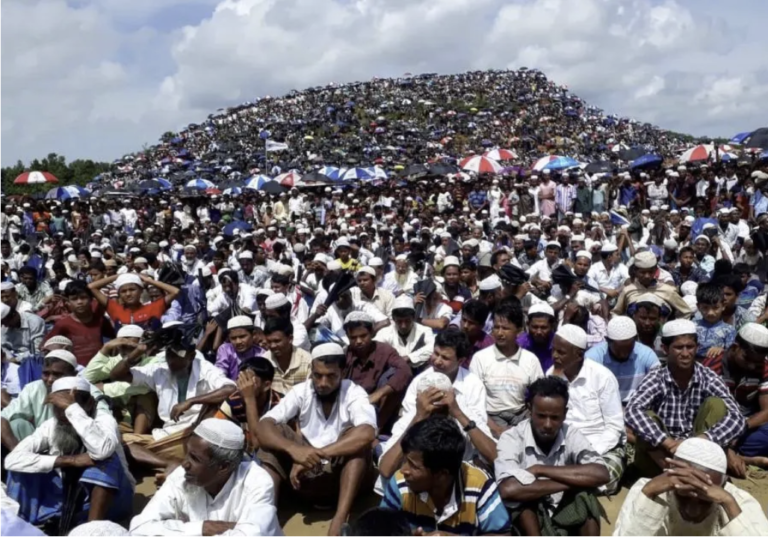
A high-level international conference held on the sidelines of the United Nations General Assembly on September 30, 2025, renewed urgent calls for decisive global action against Myanmar over its continued and systematic persecution of the Rohingya Muslim population. The conference urged UN member states to impose strong and targeted sanctions on Myanmar, warning that the country is entering a new and dangerous phase of genocidal violence.
A History of Systematic Persecution
Since Myanmar’s independence from the United Kingdom in 1948, the Rohingya Muslim minority has faced decades of state-sponsored discrimination and violence in Rakhine State. This persecution escalated dramatically during the 2012 communal attacks involving Buddhist Rakhine groups and state security forces, and reached genocidal proportions during the 2016–2017 military operations carried out by the Myanmar army, known as the Tatmadaw.
Renewed Violence in Rakhine State
In 2026, Rohingya civilians continue to be targeted, displaced, and killed amid ongoing fighting between the Myanmar junta forces and the Arakan Army (AA), an ethnic Rakhine armed group that has been battling the military for control of Rakhine State since 2018.
Human rights monitors report that the Arakan Army routinely accuses Rohingya civilians of collaborating with both the Tatmadaw and the Arakan Rohingya Salvation Army (ARSA), using these allegations to justify widespread abuses.
The AA has been accused of committing crimes against humanity against the Rohingya population, including beheadings, arbitrary detention, enforced disappearances, forced labor, forced recruitment, looting, arson, and large-scale pillage. According to Unravelling the Maungdaw Exodus (Kaladan Press Network, 2024), an Arakan Army drone and mortar attack on August 5, 2024, killed at least 200 Rohingya civilians fleeing clashes in Maungdaw near the Bangladesh border. Observers note that 2024 marked the worst wave of atrocities against Rohingya since the 2016–2017 genocide.
Life Under an Apartheid System
Despite mass displacement, an estimated 630,000 Rohingya remain in Myanmar, living under an entrenched system of apartheid enforced through discriminatory laws, policies, and practices. Central to this system is the 1982 Citizenship Law, which stripped Rohingya of citizenship by excluding them from the list of officially recognized “national races.”
The Myanmar authorities continue to falsely claim that Rohingya are recent migrants from Bangladesh, despite historical evidence confirming their presence in Rakhine State long before 1823. During the 2014 national census, Rohingya were forced to identify as “Bengali,” reinforcing their exclusion and vulnerability to deportation. In the junta-organized elections of January 2026, Rohingya were once again barred from voting.
Severe restrictions on freedom of movement persist. In Sittwe, approximately 150,000 Rohingya are confined in open-air detention camps surrounded by military and police checkpoints. These restrictions severely limit access to food, employment, healthcare, and education.
Amnesty International, Genocide Watch, and other rights groups have concluded that these conditions amount to a systematic crime of apartheid under international law.
Exile, Displacement, and Fear of Repatriation
Since 2017, more than 1.1 million Rohingya have fled Myanmar, primarily seeking refuge in Bangladesh. Over the past 18 months alone, an additional 150,000 Rohingya have arrived in Cox’s Bazar, placing immense strain on already overcrowded camps facing critical shortages of food, water, healthcare, and shelter. Recent reductions in U.S. humanitarian assistance have further worsened conditions.
Bangladesh, which has not ratified international refugee conventions, does not grant asylum or citizenship to Rohingya refugees and maintains a policy of repatriation to Myanmar. However, most refugees strongly oppose returning, citing ongoing violence and persecution. A limited repatriation of 1,100 Rohingya in May 2023 was widely criticized by activists as a symbolic move aimed at easing international pressure during proceedings at the International Court of Justice (ICJ).
In a separate development, India detained and deported at least 40 Rohingya refugees from Delhi in May 2025, including individuals holding UNHCR documentation. They were reportedly abandoned at sea near Myanmar waters, in violation of the principle of non-refoulement. Several refugees are believed to have drowned.
Starvation as a Weapon of War
Since November 2023, the Myanmar junta has imposed near-total restrictions on humanitarian aid to areas of Rakhine State under its control. In territories held by the Arakan Army, Rohingya livelihoods face additional constraints. As a result, more than two million people are at risk of starvation, including over 500,000 Rohingya.
Agricultural destruction, landmine contamination, and the deliberate obstruction of food and medical supplies have triggered widespread hunger. In Pauktaw Township alone, more than 25,000 civilians have reportedly been deprived of food, leading to deaths from starvation.
Human rights experts warn that the deliberate denial of humanitarian assistance—an element of the Tatmadaw’s “Four Cuts” counterinsurgency strategy—constitutes an act of genocide when used to target a specific ethnic and religious group.
Genocide Watch Assessment
According to Genocide Watch, Myanmar has progressed through multiple stages of genocide. The denial of citizenship and freedom of movement places the country at Stage 3: Discrimination. The systematic obstruction of humanitarian aid constitutes Stage 8: Persecution. The ongoing mass killings of Rohingya civilians meet the criteria for Stage 9: Extermination.
International observers conclude that Myanmar is committing genocide against the Rohingya ethnic and religious group, and warn that failure to act will result in further mass loss of life.