


Human trafficking networks are increasingly exploiting systemic vulnerabilities inside Rohingya refugee camps, with evidence pointing to organized cross-border operations that extend from Bangladesh to Southeast Asia, according to findings discussed at a recent multi-agency workshop.
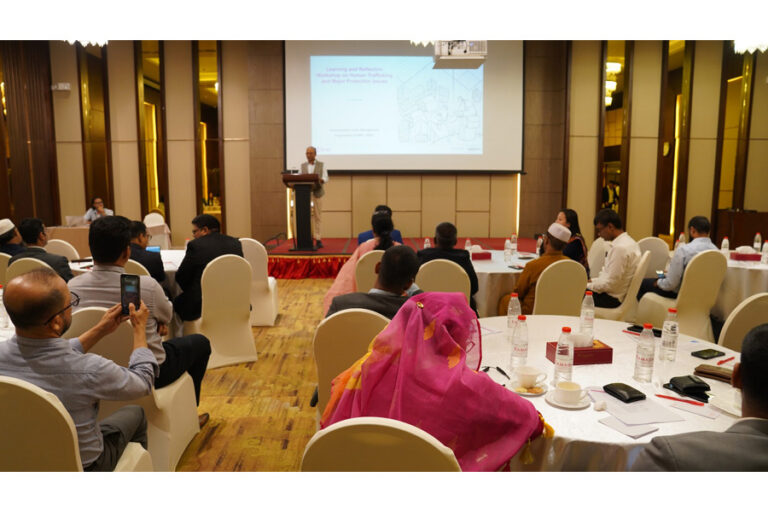
Held in Cox’s Bazar and organised by BRAC, the workshop brought together judicial authorities, law enforcement officials, and international agencies to assess trafficking patterns and institutional response gaps affecting displaced Rohingya populations.
Organized Trafficking Networks and Modus Operandi
Experts and field practitioners describe trafficking in the camps as increasingly structured, involving layered networks of recruiters, brokers, transporters, and financiers. These networks often operate across porous borders, leveraging informal communication channels and exploiting the legal invisibility of stateless populations.
Recruitment frequently begins within the camps, where traffickers target individuals facing acute economic hardship, restricted mobility, and limited access to formal employment. Victims are often promised jobs abroad or safe passage to third countries, only to be subjected to forced labor, sexual exploitation, or debt bondage.
Routes typically extend from Cox’s Bazar through maritime corridors in the Bay of Bengal and Andaman Sea, or via land pathways into neighboring countries, before onward movement toward destinations such as Malaysia or Thailand. These routes intersect with broader regional smuggling economies, complicating enforcement efforts.
Cross-Border Dynamics and Enforcement Challenges
The transnational nature of trafficking networks presents significant jurisdictional and operational challenges. Law enforcement officials highlighted difficulties in tracking movements across borders, sharing intelligence, and securing evidence admissible in court.
Representatives from the International Organization for Migration and the United Nations High Commissioner for Refugees noted that limited regional coordination mechanisms have allowed trafficking syndicates to adapt quickly to enforcement pressures.
Within Bangladesh, authorities face constraints including high caseloads, resource limitations, and frequent personnel transfers. According to workshop participants, these factors contribute to delays in investigation and prosecution, as well as reliance on informal dispute resolution mechanisms that may undermine accountability.
Survivor Barriers and Justice Gaps
Survivors of trafficking face multiple barriers in accessing justice. Weak evidence management systems, fear of retaliation, stigma, and lack of legal awareness all contribute to underreporting and case attrition.
Judicial representatives, including Mohammed Saifur Rahman Siddique, highlighted procedural complexities in prosecuting trafficking cases, particularly those involving cross-border elements and organized criminal groups.
Data presented at the workshop indicate that women and girls constitute 33 percent of victims, while 25 percent are children under 18. Reported cases increased by nearly 29 percent in 2025, suggesting both rising incidence and improved detection.
Legal Accountability: International Frameworks and Gaps
Legal experts emphasized that trafficking in persons is governed by binding international instruments, notably the UN Palermo Protocol, which supplements the United Nations Convention against Transnational Organized Crime. These frameworks obligate states to criminalize trafficking, protect victims, and cooperate across borders.
Bangladesh is a party to these instruments and has enacted domestic legislation aligned with anti-trafficking obligations. However, implementation gaps persist, particularly in victim protection, witness support, and cross-border legal cooperation.
The principle of victim-centered justice—a cornerstone of international anti-trafficking law—requires that survivors are not penalized for crimes committed as a result of being trafficked and are provided with access to legal remedies, rehabilitation, and protection.
Experts noted that the absence of comprehensive regional agreements within ASEAN and South Asia continues to limit effective enforcement against transnational trafficking syndicates.
Humanitarian Response and Prevention Efforts
BRAC reported that it has provided legal support to 784 trafficking survivors between 2017 and March 2026. In parallel, community-based prevention programs have trained 400 Rohingya teachers, volunteers, and leaders to identify risks and raise awareness within the camps.
Despite these efforts, humanitarian actors warn that structural risk factors—protracted displacement, lack of formal education, limited livelihood opportunities, and movement restrictions—continue to drive vulnerability.
Toward Coordinated Regional Action
Participants at the workshop stressed that dismantling trafficking networks requires a coordinated, multi-layered approach that goes beyond camp-level interventions. Key recommendations include:
-
-
-
- Strengthening cross-border intelligence sharing and joint investigations
- Enhancing forensic and evidence management capacities
- Expanding survivor protection services and legal aid
- Establishing safe migration pathways to reduce reliance on smugglers
- Deepening cooperation with international agencies such as UNHCR and International Organization for Migration
-
-
“Trafficking networks thrive on fragmentation—between jurisdictions, institutions, and policies,” one participant noted. “Without coordinated regional action, these networks will continue to evolve faster than enforcement mechanisms.”
Conclusion
The Rohingya camps in Cox’s Bazar remain at the intersection of humanitarian crisis and transnational crime. As trafficking networks grow more sophisticated, the gap between legal commitments and operational realities continues to expose vulnerable populations to exploitation.
Addressing this crisis will require not only stronger enforcement, but also systemic reforms that integrate protection, accountability, and regional cooperation—ensuring that those fleeing persecution are not further victimized by criminal networks.