


The Arakan Army (AA) and its political wing, the United League of Arakan (ULA), have launched another round of fund collection from Rohingya villages in northern Maungdaw Township, with local residents alleging that millions of kyats are again being demanded for bridge and road repair projects.
According to Rohingya residents, this is the fourth additional fundraising campaign following several previous collections from local business owners. They claim the AA/ULA has already collected hundreds of millions of kyats from Rohingya entrepreneurs in villages under Area (6), as well as former Areas (5), (6), and Nakha Kha (10), now administered under AA/ULA Division (3).
Village sources said the latest collection drive began last week through village administrators acting on instructions from AA regional authorities.
A Rohingya elder told local media that AA officials said the funds were needed to repair the Kanyengtaw–Shwe Zar bridge and sections of the Maungdaw–Taung Pyo highway.
According to the elder, previous fundraising campaigns collected approximately 80 million kyats, 60 million kyats, 50 million kyats and 120 million kyats respectively from Rohingya business communities, amounting to nearly 300 million kyats in total. Residents said the current campaign represents another major collection effort.
Local residents reported that villages have been assigned individual financial quotas. They said Mingalar Gyi village has been instructed to contribute 100 million kyats, Shwe Zar another 100 million kyats, Kyauk Sae Lay 70 million kyats, while Hla Baw Zar and Paung Zar have each been asked to provide 40 million kyats.
Residents questioned how previously collected funds had been spent.
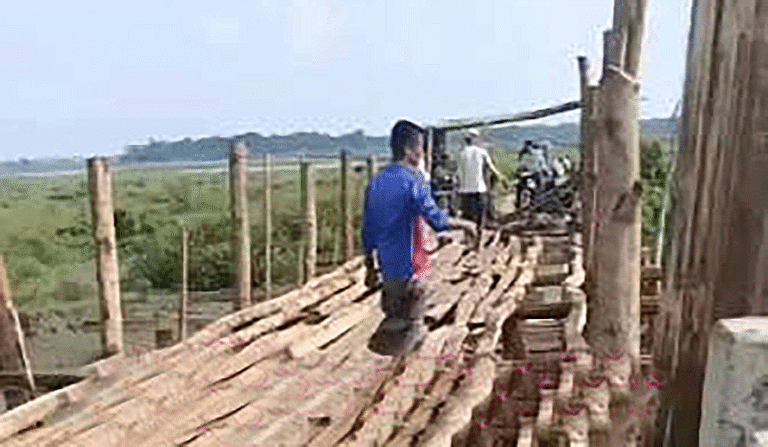
One local resident alleged that despite collecting nearly 300 million kyats for the Kanyengtaw bridge, the AA/ULA constructed only a temporary wooden bridge instead of a permanent concrete structure.
“The bridge is built with timber and wooden planks, making it vulnerable during the rainy season,” the resident said. “It has deteriorated to the point where vehicles can no longer cross safely, and only motorcycles are able to use it.”
Another resident claimed that although the AA/ULA collects money for road repairs, much of the actual construction work is carried out by Rohingya civilians.
“They collect funds for repairing the roads, but in reality they rely on Rohingya labor,” the resident said. “People are made to quarry stones from the Mayu mountain range and repair the roads themselves. Many people are asking where the money collected from Rohingya communities is actually being spent.”
Residents further alleged that while hundreds of millions of kyats were collected in the name of infrastructure development, the cost of labor was borne almost entirely by local Rohingya communities.
The AA/ULA has not publicly responded to the allegations, and the reported claims could not be independently verified.