


A Pattern of Night Arrests and Silent Disappearances
The detention of a Rohingya teacher in Buthidaung Township underscores a broader pattern of targeted arrests emerging in areas under the influence of the Arakan Army (AA).
Local monitoring indicates that nighttime operations—often without warrants or public explanation—have increased in frequency, creating an atmosphere of fear among civilians.
Such tactics mirror insurgent governance strategies aimed at:
-
-
-
- Intelligence control
- Population monitoring
- Deterrence of dissent
-
-
Gendered Impact: Why Rohingya Girls Are Fleeing
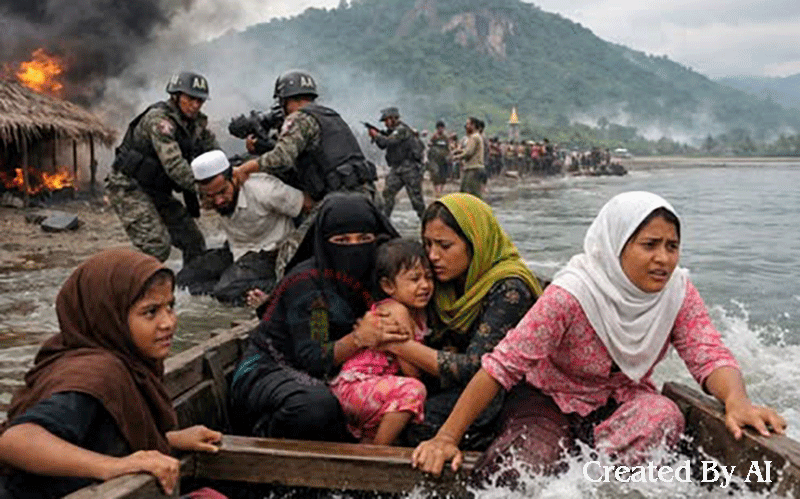
The parallel trend of Rohingya girls fleeing by sea reveals a gendered dimension of the crisis.
Field reports suggest three overlapping drivers:
-
-
-
- Fear of forced recruitment or coercion
- Economic extortion pressures on families
- Lack of protection mechanisms in conflict zones
-
-
These factors are pushing young women toward maritime escape routes—primarily toward Malaysia—despite well-documented risks of trafficking and death at sea.
The Maritime Escape Route: From Rakhine to Malaysia
The Andaman Sea corridor has re-emerged as a critical but dangerous migration route.
Trafficking networks exploit:
-
-
-
- Statelessness of Rohingya populations
- Weak maritime enforcement
- Demand for low-wage labor in regional economies
-
-
Analysts warn that increased departures from northern Rakhine may signal the reconstitution of transnational smuggling networks last seen during the 2015 Andaman crisis.
Arakan Army Governance and Rohingya Vulnerability
The rise of the AA as a dominant force in Rakhine has fundamentally altered the security architecture.
While the group seeks legitimacy as a governing authority, reports indicate:
-
-
-
- Selective enforcement of control over Rohingya communities
- Allegations of taxation and financial demands
- Limited transparency in detention practices
-
-
This creates a paradox: expanded order in some areas, but increased insecurity for minority populations.
Bangladesh–Myanmar Spillover Risks
Developments in Buthidaung have direct implications for Bangladesh, which hosts over a million Rohingya refugees.
Potential spillover risks include:
-
-
-
- Renewed influx of refugees across the border
- Expansion of trafficking networks into Cox’s Bazar camps
- Security concerns linked to armed group influence
-
-
These dynamics further strain already fragile Bangladesh–Myanmar relations.
International Law and Protection Gaps
Under international legal frameworks supported by the United Nations, arbitrary detention and forced displacement raise serious human rights concerns.
Additionally, ongoing proceedings at the International Court of Justice (ICJ) continue to scrutinize Myanmar’s treatment of the Rohingya.
Key legal issues include:
-
-
-
- Protection from arbitrary arrest
- Prevention of trafficking and exploitation
- Ensuring safe and voluntary movement
-
-
However, enforcement remains weak in conflict-affected zones.
Conclusion: A Crisis Evolving in New Directions
The arrest of a single teacher and the flight of vulnerable young women are not isolated incidents—they are indicators of a shifting crisis.
As the Arakan Army consolidates control and regional migration pressures intensify, the Rohingya situation is entering a new phase marked by:
-
-
-
- Fragmented authority
- Gender-specific vulnerabilities
- Expanding transnational risks
-
-
Without coordinated regional and international intervention, these trends threaten to deepen one of the world’s most protracted humanitarian crises.


