


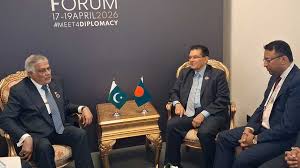
Bangladesh’s Foreign Minister Khalilur Rahman has renewed calls for a “coordinated global initiative” to resolve the Rohingya crisis, but beneath the diplomatic language lies a far more complex matrix of legal obligations, armed power dynamics, and geopolitical inertia.
Speaking at the Antalya Diplomacy Forum, Rahman’s appeal reflects mounting pressure on Bangladesh as the Rohingya population in Cox’s Bazar approaches unsustainable levels. Yet, the feasibility of repatriation hinges not only on political will—but on compliance with international law and the realities of control inside Rakhine State.
I. Repatriation and International Law: Between Obligation and Impossibility
At the heart of the Rohingya crisis lies a fundamental legal principle: voluntary, safe, and dignified repatriation, enshrined in international refugee law and reinforced by the principle of non-refoulement.
However, current conditions in Rakhine State raise serious legal barriers:
-
-
-
- The absence of citizenship rights for Rohingya under Myanmar’s 1982 Citizenship Law
- Ongoing armed conflict and fragmented territorial control
- Documented risks of persecution, arbitrary detention, and statelessness
-
-
These conditions directly challenge the legal thresholds required for lawful repatriation.
ICJ Proceedings: State Responsibility
The case brought by The Gambia against Myanmar at the International Court of Justice (ICJ) alleges violations of the Genocide Convention.
Key implications:
-
-
-
- Myanmar is under provisional measures to prevent genocidal acts and preserve evidence
- The case frames the crisis as a matter of state responsibility, not merely humanitarian concern
- A final ruling—still pending—could establish binding obligations for reparations and safe return conditions
-
-
ICC Jurisdiction: Individual Criminal Liability
Separately, the International Criminal Court (ICC) has authorized an investigation into crimes related to the forced deportation of Rohingya into Bangladesh.
This introduces:
-
-
-
- Potential prosecution of senior Myanmar officials
- Legal recognition of cross-border forced displacement as a crime against humanity
- Increased scrutiny over any repatriation process that lacks accountability mechanisms
-
-
Analytical Insight:
While the ICJ addresses state conduct, the ICC focuses on individual criminal responsibility—together forming a dual-track accountability framework that complicates diplomatic engagement.
II. Arakan Army and the Fragmentation of Authority
Any discussion of repatriation must confront a critical reality: Myanmar no longer exercises uncontested control over Rakhine State.
The Arakan Army (AA), an ethnic Rakhine armed group, has emerged as a dominant force across large parts of the region.
Governance Without Recognition
-
-
-
- The AA has established parallel administrative structures in areas under its control
- It presents itself as a potential guarantor of local stability
- However, it lacks international legal recognition as a state actor
-
-
Foreign Minister Rahman’s remark that both the Myanmar military and the AA have “welcomed” engagement suggests a rare—but fragile—diplomatic opening.
Key Risk:
Repatriation agreements negotiated solely with the central military government may be operationally irrelevant in areas controlled by the AA.
Key Question:
Can international actors engage non-state armed groups without conferring legitimacy—or undermining state sovereignty?
III. Bangladesh at the Geopolitical Crossroads
Bangladesh’s position is increasingly precarious.
With Rohingya numbers rising—from just over 1 million in 2025 to nearly 1.2 million in 2026, according to the United Nations High Commissioner for Refugees—Dhaka faces:
-
-
-
- Economic strain on host communities
- Security concerns, including trafficking and armed recruitment risks
- Environmental degradation in and around refugee camps
-
-
Yet Bangladesh’s strategic leverage remains limited.
Bilateral Constraints
-
-
-
- The 2017 Bangladesh–Myanmar repatriation agreement failed due to lack of trust
- Attempts in 2019 collapsed as refugees refused to return without guarantees of rights and safety
-
-
Regional Paralysis
The Association of Southeast Asian Nations (ASEAN) has struggled to mount an effective response:
-
-
-
- Its non-interference principle limits collective pressure on Myanmar
- The Five-Point Consensus on Myanmar remains largely unimplemented
-
-
Major Power Dynamics
-
-
-
- China prioritizes stability and border security, maintaining ties with Myanmar’s military
- India balances security concerns with strategic competition with China
- Western actors focus on sanctions and legal accountability, but lack direct leverage on the ground
-
-
Geopolitical Reality:
The Rohingya crisis persists not due to lack of awareness—but due to conflicting strategic interests among key global and regional actors.
IV. The Funding Crisis: Humanitarian Fatigue Sets In
Rahman’s warning about declining international funding reflects a broader trend of donor fatigue.
Despite escalating needs:
-
-
-
- Funding for Rohingya operations has steadily declined
- Food rations and essential services face repeated cuts
- Long-term solutions remain underfunded compared to emergency responses
-
-
This creates a dangerous feedback loop:
Reduced funding → deteriorating camp conditions → increased instability → greater barriers to repatriation
V. A “Solvable Problem”? Conditions for Resolution
Rahman’s assertion that the crisis is “solvable” is legally and politically accurate—but only under specific conditions:
Minimum Preconditions for Repatriation
- Legal Status: Restoration of citizenship or legal identity for Rohingya
- Security Guarantees: Verifiable protection from persecution and violence
- Accountability: Progress in ICJ and ICC processes
- Territorial Access: Coordination with all controlling authorities, including the AA
- International Monitoring: Robust third-party oversight mechanisms
Conclusion: Between Diplomacy and Reality
The Rohingya crisis is no longer merely a humanitarian emergency—it is a test case for the international legal order and regional diplomacy.
Calls for coordinated global action, such as those made by Khalilur Rahman, underscore a growing recognition: without aligning legal accountability, geopolitical interests, and on-the-ground realities, repatriation will remain aspirational.
Until then, Bangladesh will continue to shoulder a disproportionate burden—while the conditions necessary for return remain structurally out of reach.


