


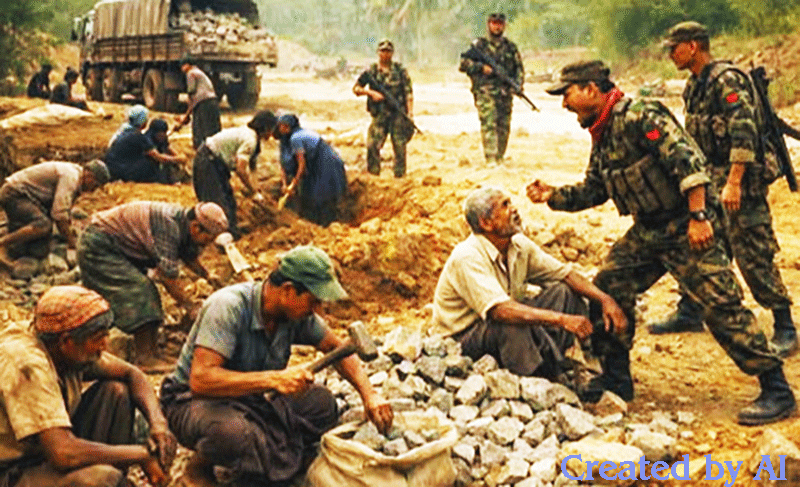
Fresh allegations of systematic forced labor imposed on Rohingya civilians in northern Maungdaw Township are raising serious legal concerns under international humanitarian and labor law, while also exposing the evolving governance model of the Arakan Army (AA).
Multiple local testimonies indicate that the AA has been compelling approximately 50 Rohingya from each village in designated zones to perform rotational labor on infrastructure projects and military-linked construction, including road repairs and bunker excavation near strategic positions.
I. Patterns of Forced Labor: Systematic and Rotational
Accounts from affected villages—including Paung Zar, Hlabaw Zar, Kyauklayga, and Mingalargyi—point to an organized system:
-
-
-
- Fixed quotas (approximately 50 individuals per village)
- Mandatory three-day labor rotations
- Work involving heavy manual tasks such as rock-breaking, transport, and tunnel digging
- No provision of wages, food, or water
- Threats, verbal abuse, and coercion for non-compliance
-
-
Workers are reportedly required to self-finance their subsistence while engaged in physically demanding labor, exacerbating already severe economic vulnerability.
Analytical Observation:
The quota-based rotation system suggests institutionalization rather than ad hoc coercion, indicating administrative coordination within AA-controlled areas.
II. Legal Classification: Forced Labor Under International Law
ILO Framework
Under the International Labour Organization (ILO) Forced Labour Convention (No. 29), forced or compulsory labor is defined as:
“All work or service which is exacted from any person under the menace of any penalty and for which the said person has not offered himself voluntarily.”
Based on available testimonies:
-
-
-
- Absence of consent: Villagers are compelled through coercion
- Menace of penalty: Reports of intimidation and verbal abuse
- No compensation: No wages or material support provided
-
-
These elements collectively meet the legal threshold for forced labor under international standards.
Customary International Humanitarian Law
Even though the AA is a non-state armed group, it remains bound by customary international humanitarian law applicable in non-international armed conflicts.
Relevant prohibitions include:
-
-
-
- Forced labor imposed on civilians for military purposes
- Collective punishment or coercion
- Exploitation of protected civilian populations
-
-
III. Geneva Conventions: War Crime Implications
Under the Geneva Conventions—particularly Common Article 3 and Additional Protocol II:
-
-
-
- Civilians must be protected from violence, coercion, and degrading treatment
- Compelling civilians to support military operations may constitute a war crime, especially when linked to military infrastructure (e.g., bunkers, strategic roads)
-
-
Legal Risk Assessment:
If substantiated, the alleged practices could qualify as:
-
-
-
- War crimes (forced labor tied to military objectives)
- Serious violations of international humanitarian law
- Potential grounds for future accountability under international mechanisms
-
-
IV. The Arakan Army’s Governance Model: Control Without Recognition
The allegations also shed light on the AA’s broader transformation—from an insurgent force into a de facto governing authority in parts of Rakhine State.
-
-
-
- Emerging Administrative Features
- Territorial control over significant areas of northern Rakhine
- Parallel governance structures, including taxation and local administration
- Infrastructure development initiatives, including roads and logistical networks
- Coercion as Governance Tool
-
-
However, the reported use of forced labor reveals a critical feature of this governance model:
-
-
-
- Resource extraction through coercion, rather than institutional service delivery
- Reliance on civilian labor to sustain infrastructure and military logistics
- Limited safeguards for minority populations, particularly Rohingya communities
-
-
Key Tension:
The AA seeks legitimacy as a governing actor, yet practices such as forced labor undermine compliance with international norms required for political recognition.
V. Rohingya Vulnerability: Statelessness and Exposure
The impact on Rohingya civilians is particularly acute due to structural vulnerabilities:
-
-
-
- Lack of citizenship and legal protection in Myanmar
- Limited access to income, food security, and mobility
- Exposure to multiple armed actors with minimal accountability mechanisms
-
-
As one Rohingya shopkeeper described, forced labor demands amid food shortages amount to a “double burden,” pushing already impoverished families deeper into crisis.
VI. Verification Challenges and Information Constraints
Independent verification of conditions in northern Rakhine remains severely restricted:
-
-
-
- Limited access for international observers and humanitarian agencies
- Communication barriers and security risks for local informants
- Reliance on testimonial evidence and local reporting networks
-
-
These constraints complicate documentation efforts but do not negate the consistency of reported patterns.
VII. Broader Implications: Repatriation and International Engagement
The allegations carry direct implications for ongoing discussions about Rohingya repatriation:
-
-
-
- Legal incompatibility: Forced labor conditions violate minimum standards for safe and dignified return
- Security concerns: Civilian coercion signals unstable and unsafe conditions
- Governance fragmentation: Engagement must consider both state and non-state actors, including the AA
-
-
Strategic Dilemma:
International actors face a complex choice—whether and how to engage with non-state authorities like the AA to ensure civilian protection without conferring formal legitimacy.
Conclusion: Governance, Legitimacy, and Legal Accountability
The emerging picture from Maungdaw is not only one of humanitarian distress—but of governance under contestation, where armed authority intersects with legal ambiguity.
For the Arakan Army, the challenge is clear:
claims to administrative control and future political relevance will increasingly be measured against adherence to international legal norms.
For the international community, the stakes are equally significant:
failure to address forced labor and civilian protection risks embedding systemic abuses into any future political settlement in Rakhine State.
Until accountability mechanisms and protective frameworks are enforced, the conditions necessary for safe, voluntary, and dignified Rohingya return remain fundamentally unmet.


