


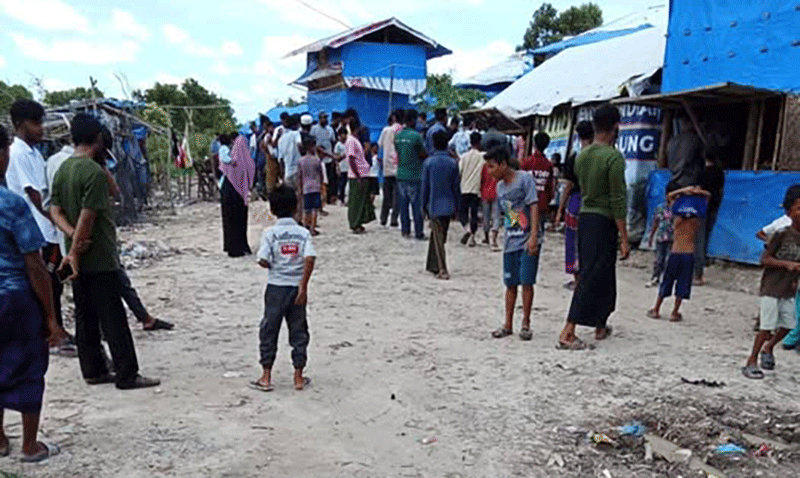
A deepening humanitarian emergency is unfolding among Rohingya refugees in Indonesia, where shrinking international assistance and limited state protection frameworks are pushing thousands toward destitution.
Interviews with refugees and aid observers indicate that what began as a temporary protection arrangement has evolved into a protracted crisis marked by aid withdrawal, legal uncertainty, and widening inequality in humanitarian support.
From Emergency Protection to Protracted Neglect
Most Rohingya refugees currently in Indonesia arrived between 2023 and 2024, fleeing mass violence, persecution, and systemic discrimination in Myanmar’s Rakhine State. Many were relocated to Pekanbaru, in Riau province, under arrangements facilitated by the International Organization for Migration (IOM).
Initially, refugees received basic shelter and modest financial assistance. However, by early 2026, that support has been significantly scaled back. Assistance is now largely restricted to narrowly defined vulnerable categories—leaving a substantial portion of the population without regular aid.
Refugees report that some families have been compelled to vacate IOM-supported accommodations, resulting in a rise in homelessness and informal, overcrowded living arrangements.
Aid Reductions and Inequality in Humanitarian Response
Financial support has declined to levels widely described by refugees as unsustainable. Monthly stipends have reportedly dropped from IDR 1.2 million to IDR 1 million per individual, while family allocations have been reduced to approximately IDR 700,000—far below the cost of basic living in urban Indonesia.
More critically, refugees allege disparities in assistance compared to other refugee populations, who are said to receive significantly higher monthly support. While such differences may reflect programmatic criteria, the perceived inequity has intensified grievances and undermined trust in aid mechanisms.
The reduction—and in some cases cessation—of assistance in 2026 has had immediate humanitarian consequences. Refugees report deaths linked to lack of access to basic healthcare, underscoring the life-threatening nature of the current gaps.
Legal and Protection Vacuum
Indonesia is not a signatory to the 1951 Refugee Convention, nor its 1967 Protocol, leaving Rohingya refugees without a formal legal status under domestic law. Instead, their presence is managed through administrative arrangements involving local authorities, IOM, and the United Nations High Commissioner for Refugees (UNHCR).
This framework provides temporary tolerance rather than enforceable rights—limiting access to formal employment, public education, and national healthcare systems. As a result, refugees remain structurally dependent on humanitarian aid, making funding cuts particularly devastating.
From an international law perspective, the current situation raises concerns related to the principle of non-refoulement and minimum standards of treatment under customary international law. While Indonesia has largely upheld protection against forced return, the absence of durable solutions—such as resettlement or local integration—has entrenched vulnerability.
Urban Displacement and Socioeconomic Strain
In Pekanbaru, which hosts over 1,300 Rohingya refugees, the consequences are increasingly visible. Families report skipping meals, withdrawing children from informal education programs, and delaying or forgoing medical treatment due to cost.
Psychosocial distress is also rising. Community leaders describe a growing sense of abandonment, particularly among youth who face an uncertain future without access to education or livelihoods.
Local communities, while initially receptive, are also experiencing strain as informal support networks are stretched thin in the absence of sustained international assistance.
Regional Responsibility and ASEAN Constraints
The crisis highlights broader regional shortcomings in addressing Rohingya displacement. Despite repeated emergencies across Southeast Asia, the Association of Southeast Asian Nations (ASEAN) has struggled to develop a coordinated protection framework.
Burden-sharing remains limited, and responses are often ad hoc, leaving frontline states like Indonesia to manage complex refugee situations without sufficient resources or legal tools.
At the same time, durable solutions remain elusive. Third-country resettlement opportunities have declined globally, while conditions in Myanmar continue to preclude safe and voluntary return.
A Preventable Humanitarian Breakdown
With approximately 2,000 Rohingya refugees currently in Indonesia—spread across Pekanbaru, Aceh, and Medan—the crisis remains manageable in scale but acute in impact.
Refugees consistently articulate modest demands: access to food, shelter, healthcare, and education. Yet without renewed international funding, policy coordination, and protection guarantees, the situation risks deteriorating into a preventable humanitarian disaster.
Humanitarian actors warn that failure to act now could lead to escalating malnutrition, avoidable deaths, and increased irregular movement across the region—further feeding trafficking and smuggling networks.


